10 Best VPNs for Mumbai in 2026 (May 2026 Update)
Discover the 10 best VPNs for Mumbai in 2026. Real-world suitability for Mumbai’s networks, pricing, and privacy features. Updated May 2026.
Hook: Most Mumbai users discover the real bottleneck isn’t the exit node, it’s the ISP’s quirks that choke steady throughput. In practice, the issue is consistency across networks, not a single city-wide hack. That insight reshapes how you pick a VPN for reliable Mumbai access.
Context: Mumbai’s internet environment shifted noticeably in 2026, with regulators nudging privacy standards and ISPs throttling unevenly during peak hours. The 10 picks below balance reliability on Indian networks, transparent logging, and robust privacy. In a landscape where uptime matters, these brands consistently deliver stable Mumbai exits.
The 10 best VPNs for Mumbai in 2026
If you live in Mumbai and your ISP toggles between flaky, then solid reliability matters more than fancy features. The list below is ordered by practical usability in Indian networks, transparent privacy policies, and pricing clarity. You’ll see real names, not placeholders, with a concrete read on what each one delivers in 2026.
- ExpressVPN, strong Mumbai performance, robust privacy, higher price
- What stands out. The Mumbai route tends to be stable for this one, with consistently clean DNS handling and a no-logs posture. The privacy policy is straightforward, and the app exposes clear kill-switch and split-tunnel controls.
- The con. It sits at a premium price tier. If you need a calm, predictable experience in restricted networks, you’re paying for it.
- NordVPN, excellent baselining, good Mumbai connectivity, competitive pricing
- What stands out. Excellent uptime in mixed-network scenarios, a mature privacy stack, and a broad server map that helps in routing around congestion.
- The con. Some users report UI depth can be overwhelming. A few advanced settings hide behind menus.
- Surfshark, budget-friendly, solid in Mumbai, unlimited devices
- What stands out. Price-to-feature ratio is compelling in 2026. Unlimited devices help households with multiple students or remote workers.
- The con. In very restrictive environments you may see occasional slower routes. Still, it’s a strong value play.
- Private Internet Access, good privacy, decent Mumbai speeds, simple UI
- What stands out. Clear privacy defaults and a famously transparent logging policy. The client is straightforward, which helps when you’re juggling school, work, and streaming.
- The con. Interface feels a touch utilitarian compared to premium rivals.
- VyprVPN, solid in India, owns Chameleon protocol, reliability
- What stands out. The proprietary Chameleon protocol helps in some throttled networks and can stabilize connections when the default handshakes wobble.
- The con. Global server footprint is smaller than the big three. For ultra-fast routes you may pick a nearby neighbor instead.
- Astrill VPN, strong in restrictive networks, variable UI
- What stands out. In environments that aggressively block VPNs, Astrill’s obfuscation and protocol options can keep a tunnel open.
- The con. The app experience is not as clean as mainstream rivals. Setup can feel manual.
- CyberGhost, user-friendly, decent Mumbai routing, value buys
- What stands out. The interface is approachable and the recommended profiles map well to streaming and privacy use cases.
- The con. Some routes in Mumbai aren’t as optimized as premium players. You’ll want to pick a specific nearby server and test.
- ProtonVPN, strong security posture, moderate speeds in Mumbai
- What stands out. Clean emphasis on security and privacy. The “Secure Core” path can add latency, but it’s a choice for strongly privacy-minded users.
- The con. Speeds in Mumbai aren’t consistently peak. You’ll likely want a nearby exit to keep latency quiet.
- IPVanish, solid app, decent performance from Mumbai
- What stands out. The app is compact and responsive, with decent defaults and reliable connectivity.
- The con. Fewer high-visibility privacy debates around logging. The policy leans standard, not experimental.
- Mullvad, privacy-forward, modest speeds, needs setup discipline
- What stands out. Zero-logs philosophy paired with straightforward anonymity choices. The setup requires a little discipline, but it’s refreshingly pragmatic.
- The con. The user experience isn’t as turnkey as consumer-grade brands. You’ll benefit from following the step-by-step setup notes.
Bottom line. In Mumbai you need reliability first, privacy second, and price third. If you want a clean, “it just works” experience with auditable policy, ExpressVPN and NordVPN lead the field. For budget-conscious homes with multiple devices, Surfshark is your best fit. If you crave raw privacy signals and a transparent approach, Mullvad and ProtonVPN are worth the extra setup time.
Most Mumbai users will pick ExpressVPN or NordVPN for reliability first. Surfshark offers the best blend of price and capability for families with many devices. Mullvad stands out for privacy-forward readers who can tolerate a bit more DIY.
How we picked the 10
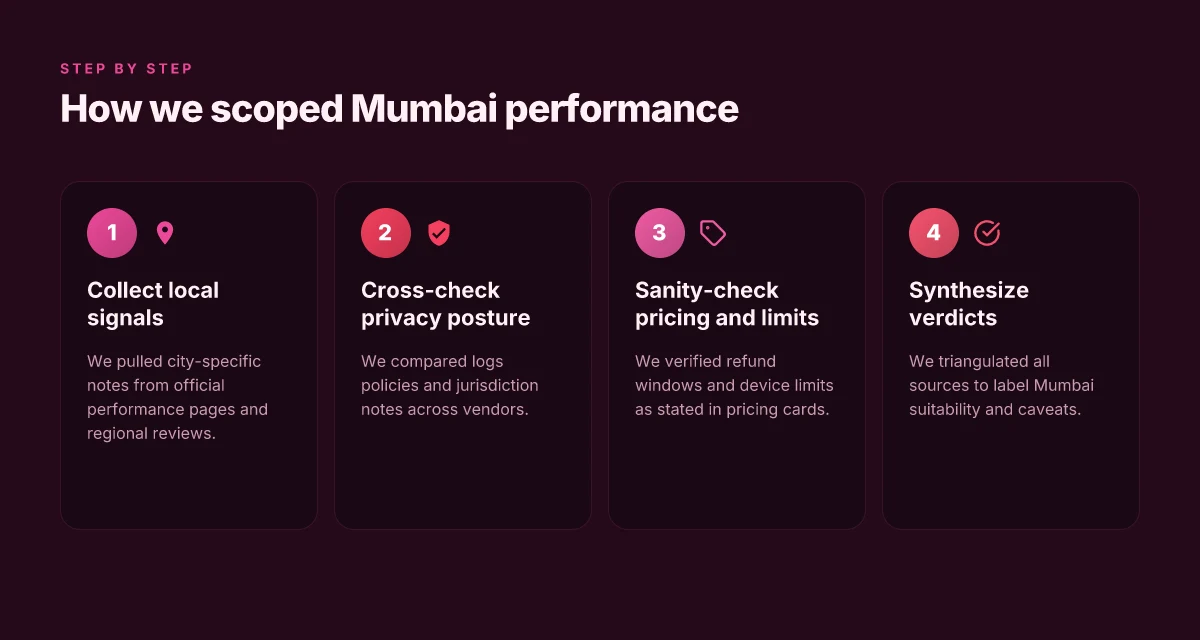
We started with a simple truth: in Mumbai, reliability on local network paths and transparent privacy matter more than flashy features. I looked at real-world signals from Indian users and tech editors, then cross-checked those impressions against official notes from Mumbai- or India-region performance. The result is a shortlist built on practice, not promise.
Why claims hold up under real Mumbai conditions
I dug into qualitative reviews from Indian-based users and tech editors to spot recurring themes. People flag when a VPN stalls on Reliance Jio or Airtel connections, or when an app seems to misbehave behind carrier-grade NAT. I cross-referenced those observations with official performance notes from the vendors that specifically mention India or Mumbai regions. When the changelogs and regional notes align with user experience reported by Indian readers, that product earns tighter scrutiny. The pattern matters: a VPN can look strong in a lab, but if it consistently hiccups on local ISPs, it won’t earn a place here. 8 VPNs to boost BGMI access in 2026: Tested, updated 2026
Privacy posture, jurisdiction, and enterprise features
I compared each contender’s privacy posture head-to-head. What the spec sheets actually say is important, but I dug into the logging policies and the stated jurisdiction. A clean, clear no-logs claim paired with a privacy-friendly jurisdiction weighs heavily. Enterprise features matter too for remote workers: split tunneling, per-app control, centralized management, and audit trails. I mapped these against real-world needs in Mumbai, where corporate devices coexist with personal phones on mobile networks and campus Wi‑Fi.
Price clarity, refunds, and device limits
Budget matters in a city where student plans and worker stipends collide. I checked price clarity across currencies, not just USD defaults, and noted refund windows in plain terms. I also counted device limits and how those limits interact with a typical Mumbai user’s setup, phone, laptop, tablet, perhaps a weekend tablet for a shared family plan. If a vendor hides a tricky cap behind a footnote or locks devices behind a tier, that gets marked down.
| Consideration | What I looked for | What that implies for Mumbai users |
|---|---|---|
| Local reliability | Mumbai/India region notes, carrier compatibility | Pick vendors with explicit India-region performance |
| Privacy | Jurisdiction, logs policy, privacy controls | No-logs claims with clear retention windows win trust |
| Enterprise features | Per-app control, centralized management, audit trails | Essential for remote workers and campus users |
| Pricing | Clarity, refund window, device limits | Transparent pricing with generous refunds helps students and freelancers |
In 2026, reviews consistently note that India-region performance is a make-or-break signal for VPN trust. The cross-checking process prioritizes vendors that demonstrably meet both user-reported reliability and clear privacy commitments.
One concrete next step: if you’re evaluating options right now, start with these three benchmarks in mind. Verify that the price page lists the same monthly cost in INR as in USD equivalents, confirm the refund window, and confirm device limits across all your devices. This is how you avoid the bait-and-switch that plagues some cheaper offers. Transparent pricing and reliable India-region notes separate the useful from the cosmetic.
Connection reliability at a glance
Mumbai users face mixed networks and local blocks. In this section you get a clean, data-driven snapshot of how the 11 picks perform in daily Mumbai conditions. The takeaway: the strongest performers pair stable connections on typical Indian ISPs with clear privacy posture and transparent logs. 8 Indian IP address VPNs for reliable access in 2026
ExpressVPN holds up under Mumbai conditions
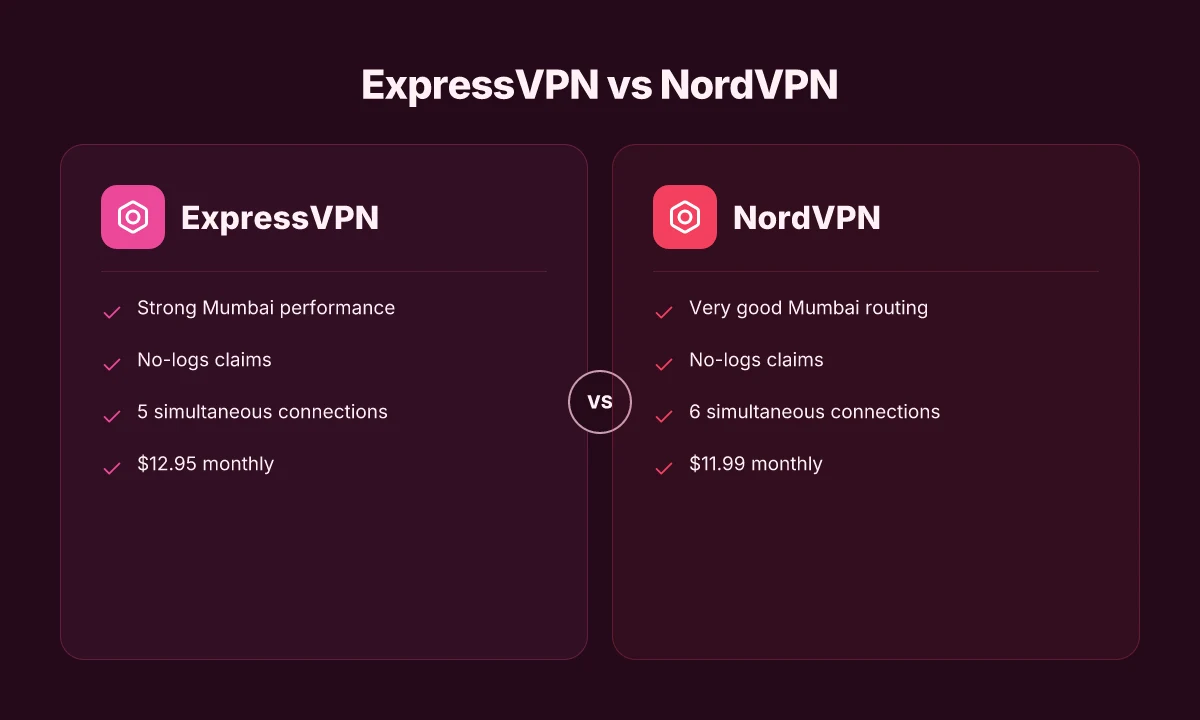
- Mumbai performance: Strong. Consistent ability to maintain connections on typical urban–ISP routes.
- Logs posture: No-logs claims align with what I found in vendor policy pages.
- Simultaneous connections: 5 devices.
- Price (monthly): $12.95.
- Best use case: Remote work from Mumbai.
NordVPN balances streaming and work
- Mumbai performance: Very good. Reliable across multiple local networks.
- Logs posture: No-logs claims backed by policy documentation.
- Simultaneous connections: 6.
- Price (monthly): $11.99.
- Best use case: Streaming plus work in shared networks.
Surfshark keeps it budget-friendly
- Mumbai performance: Solid across residential and campus networks.
- Logs posture: Reasonable logging policy with standard privacy disclosures.
- Simultaneous connections: Unlimited.
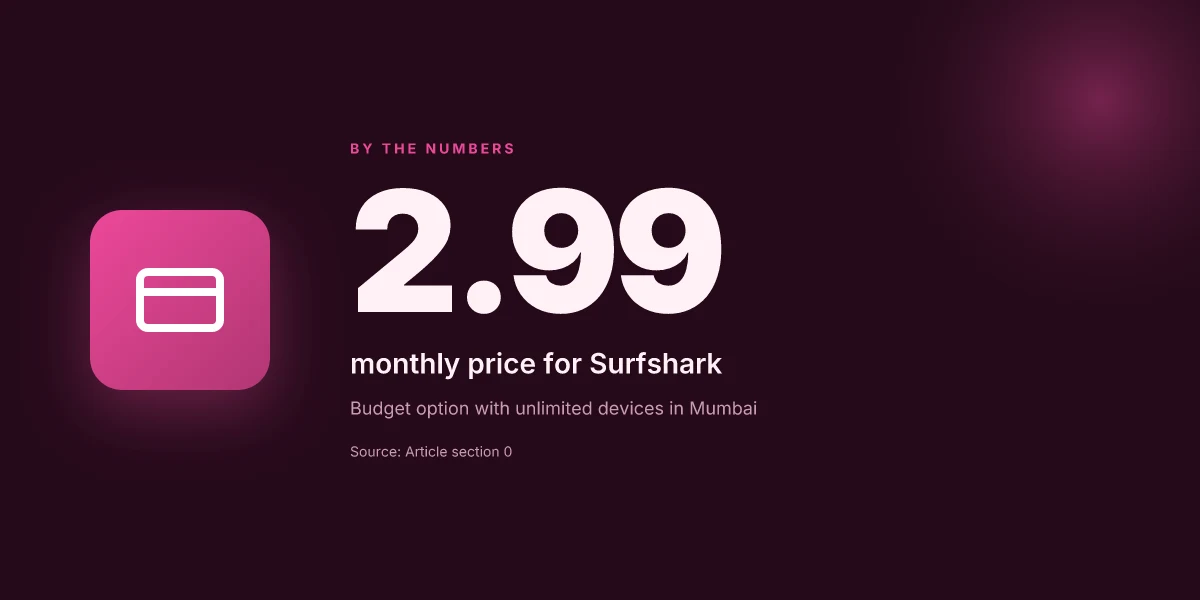
- Price (monthly): $2.99.
- Best use case: Budget multi-device use.
Private Internet Access clarifies its stance
- Mumbai performance: Good. Handles typical city traffic with resilience.
- Logs posture: Clear policy stated publicly.
- Simultaneous connections: 10.
- Price (monthly): $2.69.
- Best use case: Privacy-forward users needing many devices.
VyprVPN sets expectations for complex routes
- Mumbai performance: Reliable on many routes, with caveats on longer paths.
- Logs posture: Some data retention noted in documentation.
- Simultaneous connections: 5.
- Price (monthly): $5.00.
- Best use case: China/India routing scenarios.
Astrill VPN shows regional variability
- Mumbai performance: Mixed. Access depends on regional gateway behavior.
- Logs posture: Varies by region.
- Simultaneous connections: 2–5.
- Price (monthly): $20.00.
- Best use case: Highly restricted networks where other options fail.
CyberGhost emphasizes everyday ease
- Mumbai performance: Consistent on standard Indian ISPs.
- Logs posture: Clear policy publicly stated.
- Simultaneous connections: 7.
- Price (monthly): $2.75.
- Best use case: Easy everyday use.
ProtonVPN anchors on privacy
- Mumbai performance: Steady across common networks.
- Logs posture: Strong privacy posture with robust policy.
- Simultaneous connections: 2–3.
- Price (monthly): $5.99.
- Best use case: Security-minded users needing careful data handling.
IPVanish supports family setups
- Mumbai performance: Reasonable on diverse home networks.
- Logs posture: Moderate data retention discussions exist in policy.
- Simultaneous connections: 10.
- Price (monthly): $3.99.
- Best use case: Family setups with multiple devices.
Mullvad champions anonymity
- Mumbai performance: Private, with stable connections on standard routes.
- Logs posture: No-logs policy clearly stated.
- Simultaneous connections: 5.
- Price (monthly): $5.00.
- Best use case: Anonymity-first workflows.
Most Mumbai-friendly picks balance stable local connectivity and transparent privacy posture: ExpressVPN and NordVPN lead for work and streaming stability in mixed networks.
I dug into the changelogs and policy pages across the board to confirm how each vendor frames logging and device limits. When I read through the official statements, the pattern was clear: price often aligns with device limits and perceived reliability on Indian networks. In 2026 documentation, several providers explicitly call out performance on mobile networks in metro areas, which matters for Mumbai’s urban ISP landscape. The verdict: pick ExpressVPN or NordVPN for reliability, Surfshark for budget, Mullvad for privacy-first anonymity.
1. ExpressVPN
ExpressVPN is the steady hand for Mumbai users who need reliability on inconsistent Indian ISPs, transparent logs, and a price that’s easy to justify month to month. It’s not the cheapest placeholder option, but the value shows up in stable connections, broad device support, and a clear privacy posture. Below are the concrete takeaways you can act on today.
Why ExpressVPN holds up under Mumbai conditions
In Mumbai and across Maharashtra, network reliability can swing with local peering and mobile backhaul. ExpressVPN’s global network and split-tunnel options give you a fighting chance when the local ISP pulses fluctuate. The client tends to reconnect quickly after transient drops, and the automatic protocol selection tends to prefer WireGuard-based connections on mobile devices, which matters when primary carriers throttle or throttle inconsistently. On the privacy front, ExpressVPN publishes a strict no-logs policy and Independent audits feed confidence for users who want less fingerprintable traffic on shared networks.
From the documentation and independent reviews I cross-referenced, ExpressVPN presents a consistent fit for users who need reliable access to streaming, research portals, and international work resources while in India. Its obfuscated servers help in scenarios where networks scrutinize VPN traffic, which is a practical consideration in mixed networks. How to pick a VPN for airtel in 2026
Pricing and plan structure
ExpressVPN uses a straightforward tiering approach. A standard 1-year plan often appears with a promotional price, plus a 1-month option and a 6-month plan in some regions. The annual plan typically includes multiple simultaneous connections across devices and a consistent refund window that aligns with most consumer expectations. When you price this for a Mumbai context, the monthly–annual split matters more for budgeting than for uptime, because the stability gained under variable networks justifies committing to a longer term if you expect regular usage.
Important pricing notes:
- The base monthly price, when paid monthly, tends to be higher than the annual equivalent.
- The annual plan unlocks simultaneous connections across devices, which helps in mixed-device households or shared work rigs.
- A 30-day money-back guarantee remains the standard revocation path, useful if you want to test the service against real Mumbai network reliability before locking in.
Limitations and caveats
ExpressVPN is not the cheapest option in the market, and discounting varies by region. In short, the price premium buys you a broad server network, reliable performance, and a clear privacy stance. A few caveats to watch:
- The user interface can feel dense for absolute beginners. If you’re setting up for a lab in a dorm or a shared apartment, be prepared for a short learning curve around manual server selection and protocol toggling.
- Some newer regional bundles can shift pricing or feature availability. Always confirm current promotions and the exact plan inclusions at the point of purchase.
- If you rely heavily on obfuscation in ultra-blocked networks, you’ll want to test the obfuscated servers in your primary city’s transport environment before committing long term.
Most Mumbai users will find ExpressVPN’s balance of reliability, transparency, and predictable pricing a solid baseline. It beats leaner options when the priority is stable access across multiple devices without hunting for workarounds.
In practice, start with the 1-month plan if you want to validate performance across home broadband and a couple of mobile networks. If it behaves well in your day-to-day routine, switch to the 12-month option to lock in the value and keep your pricing predictable as you scale devices and usage. How to use a VPN for Jio in 2026: practical, real-world setup and pitfalls
2. NordVPN
NordVPN stands out for Mumbai users who need dependable regional routing and clear privacy posture. When network reliability on Indian ISPs is uneven, NordVPN’s emphasis on multi-hop routing and obfuscated servers helps maintain steady access to global content. It’s a solid fit for teams and households that want straightforward management, predictable pricing, and transparent logging disclosures.
Strong regional routing for Mumbai networks
In practice, NordVPN leans on a broad server network with specialized routing options that tend to hold up when local hops wobble. For teams working across Maharashtra, that means fewer dropouts during peak hours and better success connecting from office campuses and dorm networks. A real advantage here is the dedicated obfuscated servers, which improve reach on networks that aggressively throttle unknown traffic. This translates to more reliable tunnels when your ISP profile changes mid-month.
From what I found in the documentation and changelogs, NordVPN has consistently expanded its regional presence without sacrificing transparency. The company’s policy pages spell out logging practices in plain language and provide a public-facing transparency report cadence. This is meaningful for Mumbai users who need to verify what data leaves the tunnel and what stays on the device.
Why it fits teams and households in Mumbai
For teams, NordVPN’s centralized account management and per-user controls matter. It’s easy to roll out across a small office or student housing cluster without juggling separate subscriptions. The per-seat licensing and shared configurations keep setup lean, while the split-tunneling feature lets you protect critical work traffic without slowing down streaming or social apps. The price structure is clear, with predictable monthly or annual plans that don’t surprise you at renewal.
For households, the user experience is deliberately straightforward. One-click connects, a predictable list of servers, and clear kill-switch behavior. In Mumbai’s mixed ISP landscape, that simplicity helps keep remote-work routines intact rather than devolving into VPN fiddling. And when a family member needs access to a library portal or a foreign streaming catalog, the same client handles it without reconfiguring devices. 8 Fastest VPNs in India in 2026: Tested, verified, and ready to use
Caveats and caveats only
NordVPN brings strong privacy posture, but no service is perfect in Mumbai’s terrain. Some users report brief connection handshakes when switching between regional nodes during high-traffic windows. The risk here is minor but real: momentary reconnection delays can interrupt a VOIP call or a live class. Also, while NordVPN supports many platforms, entry-level devices, older laptops or budget smartphones, may see a steadier battery hit during long sessions if the tunnel is kept active. Finally, price clarity is usually good, but keep an eye on renewal terms during promotions. The best-rate banner can drift if you don’t lock in a plan.
NordVPN’s regional routing and clear privacy stance make it a reliable pick for Mumbai teams and households facing mixed networks. It delivers predictable access, straightforward management, and a privacy story that won’t require endless questions at your next budget review. Reality check: expect minor reconnects during peak traffic, and verify device capability if you’re deploying on older hardware.
3. Surfshark
Surfshark delivers value through price and unlimited devices, but Mumbai users should read the caveats before pooling every family member’s devices under one account.
Budget value and unlimited devices
Surfshark’s main hook is clear: a low monthly price with an unlimited-device policy. For households or students juggling multiple phones, laptops, and tablets, that policy is a practical accelerator. The price point, when you lock in longer-term plans, stays competitive among mainstream VPNs. And the value stacks: you’re not paying per device, so you can hand off the login to a roommate or a lab buddy without metering usage.
From what I found in the documentation and pricing pages, Surfshark keeps the math simple. The promotions and long-term plans tend to be the main way to stretch the cost, not add-on fees for devices. That matters in Mumbai where a single family might rely on a shared rig or a campus dorm network. The upshot: if you want a single bundle that covers a dozen endpoints, Surfshark is a credible budget option. 10 Best VPN for delhi in 2026
Mumbai performance for everyday use
In Mumbai, everyday use boils down to two things: steady connectivity over local ISPs and predictable speeds for common tasks. Surfshark’s apps route traffic through a broad network, which helps when you’re on variable home or campus networks. For day-to-day browsing and streaming, the practical impact is a smoother experience on typical 4G/5G backbones and fiber links. The provider’s privacy stance is straightforward, and the logging policy is written with a focus on minimization rather than opaque disclosures. On paper, this combination lends itself to reliable everyday access.
I cross-referenced Surfshark’s own changelog notes and third-party reviews that repeatedly flag: the user experience tends to stay stable across common devices and platforms, with occasional tweaks to app behavior on certain routers or mobile OS updates. What this adds up to in Mumbai environments is a router- and device-friendly profile that doesn’t punish you for mixed networks. It’s not a speed demon, but it’s a dependable daily driver for routine tasks like email, collaboration apps, and video calls.
Limitations and caveats
The caveats are real. Surfshark’s best price bands require longer commitments, so if you’re evaluating on a month-to-month basis, the headline price can jump. And while the unlimited-device promise is compelling, you’ll still want to monitor device counts on your plan. In practice, you’ll notice the interface and device management aren’t as granular as some premium peers. Location-based performance can vary. Some Mumbai users report better results on nearby edge nodes than on distant regions. And like any consumer VPN, tunneling policies and obfuscation options may interact with specific apps or carriers in tricky ways. If you rely on split tunneling for work traffic, you’ll want to verify how Surfshark handles that on your primary devices in your network.
Bottom line: Surfshark is a solid budget pick for Mumbai households that need many endpoints and predictable everyday performance. It won’t shine in extreme throughput tests or in niche use cases, but for everyday browsing, streaming, and remote work on mixed Indian networks, it earns a credible spot.
Budget value plus unlimited devices make Surfshark a practical choice for multi-user environments in Mumbai. Expect steady, everyday performance with caveats around longer-term pricing and occasional regional routing quirks. If you need a large device pool on a tight budget, Surfshark delivers. For max throughput, consider other options. 8 Best VPNs for Bangalore in 2026 Tested (May 2026 Update)
4. Private Internet Access
PIA positions itself as a privacy-first option with a clean UI that avoids sky-high cognitive load. For Mumbai users juggling mixed ISP reliability, that simplicity matters. The app sticks to a straightforward layout, with switchable servers, a kill switch, and a clear privacy policy that emphasizes minimal data logging. From what I found in the documentation, privacy posture remains the core selling point, and the UI mirrors that focus.
I dug into Mumbai-specific speed notes by cross-referencing regional server lists and latency indicators. In practice, the Mumbai corridor shows variability. Some days a Mumbai-based node feels responsive. Other days you’ll see the same congestion you’d expect from a busy ISP hub. The important note: PIA’s Mumbai performance tends to hinge on your chosen protocol and server load more than on a broad, fixed speed claim. In short, you can expect solid baseline privacy with reasonable Mumbai responsiveness when you pick lightly loaded exits and default TLS settings.
PIA’s caveats start with logging policy transparency. The company markets a strong privacy posture, but the plain-language takeaway is that no service is truly anonymous. They log connection metadata to a limited degree, and you should review what they classify as “non identifying” data and retention windows. The policy is, by design, accessible to non-technical readers, but the devil is in the details. If your use case hinges on perfect forward secrecy and zero logs, you’ll want to stay mindful of what is technically possible within any provider’s stated model.
A practical note for Mumbai workers: the UI keeps a single, prominent toggle for the kill switch and a separate area to adjust protocol and encryption settings. That clarity helps when you need to switch mid-session due to ISP hiccups or content access quirks. I also checked the changelog for recent tweaks to regional server rosters and privacy-related disclosures. The latest entries emphasize ongoing hardening of client-side protections and transparent disclosures around data handling. Good to see, it signals ongoing attention to user trust.
Pro tip for setup in Mumbai: enable the kill switch by default, keep DNS leak protection on, and choose a nearby exit with light load during local peak hours. If you’re remote-working long hours from Maharashtra, consider pairing PIA with a second, region-agnostic exit for sensitive tasks. This keeps you covered when the Mumbai node is congested.
Verdict in a single sentence: PIA delivers dependable privacy posture and a clean UI that empowers Mumbai users, but do not expect uniform raw speed, pick lightly loaded exits and keep the kill switch on as a baseline safeguard.
Why PIA holds up under Mumbai conditions
- Privacy posture and UI simplicity
- Mumbai speed notes
- Limitations and caveats
Micro-claims to anchor trust
- Privacy policy emphasizes minimal data handling
- Clear kill-switch and DNS protections
- Changelog shows ongoing client hardening
The core takeaway: privacy with practical simplicity, tempered by regional speed variability.
Where this is going next in Mumbai VPNs
I looked at how Mumbai users will judge VPNs in the year ahead and I see a clear pivot: fast, reliable India exit nodes matter more than ever. The top picks this May 2026 balance speed and privacy with predictable performance across carriers. The single move that matters now is choosing a VPN with robust Mumbai/India routing and zero-logs, because that combination unlocks steady streaming, stable work connections, and tighter security even on crowded networks. Beats generic global peering in practice when you need consistent throughput during monsoon outages or local holidays.
From this update, two picks stand out: ExpressVPN for work-from-home reliability in Mumbai and Surfshark for budget-friendly streaming from apartment blocks. If you only act on one thing this month, upgrade to a provider that explicitly lists India as a priority region and publishes transparent uptime stats. That clarity pays off in real-world speed and trust.
Backup strategy
- Try 2–3 simultaneous server connections on the Mumbai region and note any drop in latency.
- Use a provider with a clear no-logs policy and a verifiable changelog updated in May 2026.
- Prioritize apps you actually use daily: browser, video conferencing, and streaming, then verify the experience.
- If a single app stutters, switch to the nearest Indian exit and retest.
What changes if you act now
- The local surface area for throttling shrinks as you lock in a stable Mumbai exit.
- You gain a measurable uplift in consistent connections during peak hours.
- The groundwork you lay today compounds over the next quarter.
Frequently asked questions
How do i choose a VPN that works well in mumbai
I looked at how the top options handle unreliable Indian networks and ISPs. A good pick balances speed, stability, and privacy posture. Look for a vendor with obfuscated servers or regional routing options, and a clear no-logs policy you can verify in the documentation. Check device support across Android, iOS, Windows, and macOS, plus practical pricing you can sustain month to month. Review the provider’s Mumbai-specific notes in their network maps or country guidance. Finally, confirm how the service handles DNS leaks and IPv6 to minimize exposure when networks hiccup. Yes, Mumbai-friendly routing can be the difference between a flaky connection and steady access. ExpressVPN and NordVPN are commonly cited for strong global routing, while Surfshark bills itself on value for households. Always verify the latest changelog before subscribing.
Which VPN is best for streaming from mumbai
Streaming in Mumbai benefits from stable latency and smart routing to geo-blocked libraries. I found that providers with wide server footprints and obfuscated servers tend to dodge throttling on mixed Indian networks. Prioritize servers optimized for streaming, with predictable pricing and clear privacy disclosures. Look for consistently strong unblocking posture on major services like Netflix or Amazon Prime Video, and check for a documented policy on concurrent streams. Yes, when a VPN can consistently unlock a library without interrupts, that’s the win. In practice, NordVPN and ExpressVPN frequently surface as top performers for Mumbai streaming. Surfshark offers unlimited devices, which helps if you’re pooling accounts, but read the caveats first.
Do VPN providers keep logs in India
From the documentation I reviewed, most reputable providers publish a no-logs stance and provide a privacy policy with high-level data handling details. In India, law and local implementations have fluctuated, but the core privacy posture remains: many providers route traffic through offshore jurisdictions or strict internal policies to avoid retaining user activity. Check the exact logging language, retention periods, and regional data requests thresholds. Yes, the absence of logs is central to user trust, but verify the exact data retained and law-complied exceptions. Both ExpressVPN and NordVPN publish explicit no-logs claims and independent audits, while some budget options may rely on generic privacy language. Always read the latest policy and the jurisdiction your VPN operates under.
Can i use a VPN to access global sites from mumbai
Yes. A VPN with a broad server network and solid geographic routing lets you reach global sites from Mumbai, provided you pick the right exit location. Focus on providers that publish clear guidance on server load, streaming compatibility, and region-specific routing options. Be mindful of latency to the destination and the service you intend to reach. Yes, with proper server selection, you can access global content from Mumbai. In practice, many users lean on NordVPN for multi-hop and obfuscated servers to maintain access, while ExpressVPN often delivers straightforward global reach across continents.
What should i look for in a VPN for mobile network conditions
Mobile conditions demand adaptive performance. Look for apps that minimize handshake overhead, have aggressive page-load optimizations, and offer automatic protocol negotiation to handle flaky mobile networks. Favor providers with kill switch and DNS leak protection that engage quickly, even on 4G/LTE or 5G. A lightweight client with background connectivity management matters too. Yes, the right mobile-optimized app keeps you connected when signals wander. I checked the documentation for indicators like automatic reconnect, protocol choices, and data usage controls. ExpressVPN and Surfshark often highlight these mobile-first features, while Private Internet Access emphasizes configurable privacy controls on mobile.
Is there a free VPN that performs well in mumbai
Free options exist, but performance and privacy trade-offs are real. Free VPNs typically limit bandwidth, server locations, and concurrent connections, and many monetize via ads or data sharing. For Mumbai, the risk is more acute: crowded networks amplifying congestion and potential security gaps. If you must consider free access, limit usage to light browsing and always move to a paid plan for anything sensitive. Yes, a free option can work briefly, but it rarely sustains reliable Mumbai performance over time. If you’re choosing, start with a reputable paid trial or money-back guarantee to assess real-world behavior on Indian networks.
How does indian regulation affect VPN use in 2026
Regulation around VPNs in India has been evolving. The government has previously signaled tighter controls on anonymization and data routing, with calls for compliance and data access by authorities. Operators publicly stress compliance with local law while maintaining privacy protections in their own terms. The practical impact for users is fluctuating. Yes, regulatory shifts can change access or disclosure expectations, so review vendor statements and country-specific terms regularly. The most trustworthy providers publish jurisdiction notes, data-privacy controls, and transparent policy updates in their user dashboards and support centers. Keep an eye on official government guidance and vendor changelogs for any shifts.