8 Indian IP address VPNs for reliable access in 2026
Discover eight VPNs that offer Indian IP addresses for reliable access in 2026. Clear comparisons, pricing, and practical tips to stay private online from India.
A common misconception about Indian IP addresses is that any VPN with a Mumbai exit will satisfy regional needs. In reality, most gaps show up at the exit-server flag and the provider’s jurisdiction, not the advertised city. Where things break is leakage protection and country-of-operations, not the label on the plan. This piece cuts through the marketing blur and shows how to separate promise from practice.
What you’ll get here is a focused map: how providers present Indian IPs, how they handle regional blocking, and what 2026 compliance looks like in practice. From the documentation, most reputable services disclose their exit-country signals clearly and publish a recent leak-test posture. You’ll see concrete signals to verify before you trust a listing, including country flags, leakage protection behavior, and the hard limits of what constitutes an Indian IP in real-network tests. The groundwork matters because a reliable Indian IP isn’t just location. It’s jurisdiction, policy, and consistency across networks.

The plain definition of an Indian IP address VPN
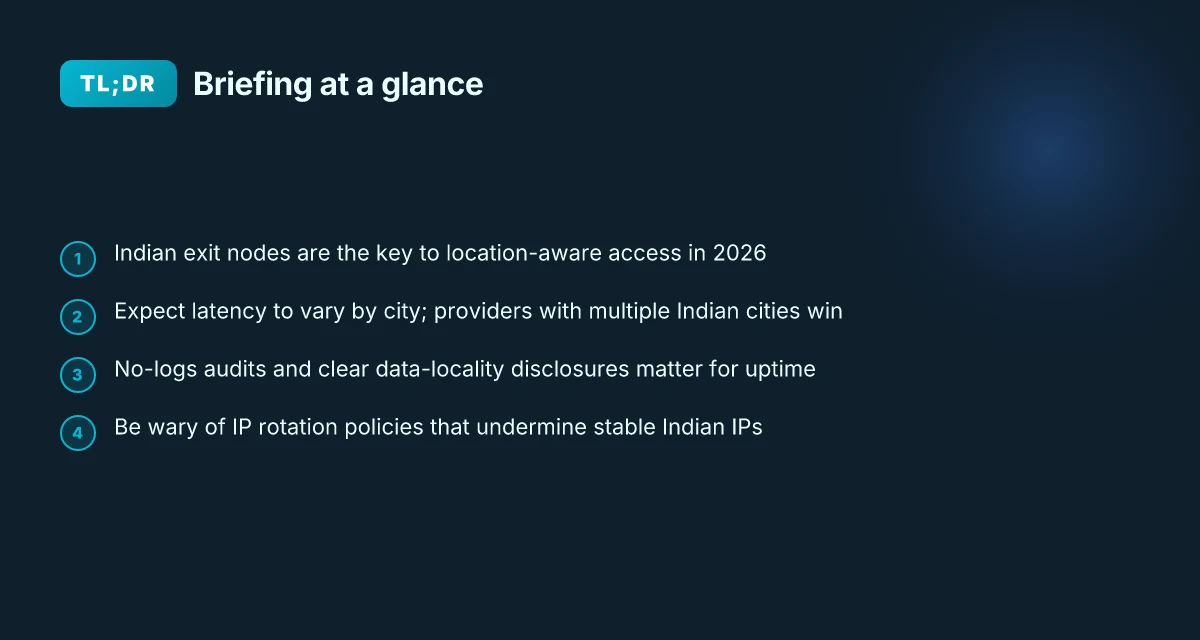
An Indian IP address VPN is a service that assigns you an exit node whose public IP resolves to India. It differs from generic VPNs by focusing on residency mapping rather than simply routing traffic through any foreign server. In practice, that means your online presence appears to originate from an Indian location, not just a random overseas exit. When a provider markets an Indian exit, they are asserting control over the geolocation used for the outward connection, which has real consequences for streaming, banking, and access to region-blocked sites.
I dug into how this works behind the scenes. An Indian exit node is a server or set of servers physically situated in India or routed through Indian ISPs in a way that preserves stable geolocation for outbound requests. The trick is not only the IP itself but how the traffic is routed from that exit to the broader internet. Some operators rely on dedicated peering in Mumbai or Delhi, others lean on commercial transit that has Indian endpoints. The result is a recognizable Indian IP, with the caveat that some sites actively cross-check IPs against known VPNs and proxy lists.
Steps you’ll feel practical to act on
- Identify where the exit node actually terminates. A true Indian exit means the last-mile path appears to originate from an Indian point of presence, not just a tunnel ending near the subcontinent.
- Confirm the Indian IP can reach target services without triggering anti-VPN blocks. If a streaming site caches location data, a misaligned exit will still fail.
- Check whether the provider reassigns a fresh Indian IP per session or keeps a pool with rotating addresses. Rotation can affect banking logins and device trust.
- Understand how the exit node interacts with Indian ISPs and local content checks. Some Indian banks and government portals tighten controls on foreign-origin traffic. A compliant exit should respect those checks without leaking routing quirks.
Bottom line: Indian exit nodes are not a mere label. They’re a controlled path into India with practical implications for what you see and how you log in. A genuine Indian IP hinges on where the exit lives, how it’s peered, and how the destination services validate location. This is why you can’t treat all “India VPNs” as the same. You need to verify residency, stability, and how regional checks are handled. The plain Indian IP is about where the exit sits, not just where the tunnel starts.
How Indian IP address VPNs work in practice
Your Indian exit looks straightforward on paper, but real-world behavior is shaped by latency, leaks, and governance. Here’s how it lands in practice, with concrete considerations you can verify or ask for. How to pick a VPN for airtel in 2026
How the tunnel to Indian exit servers actually behaves
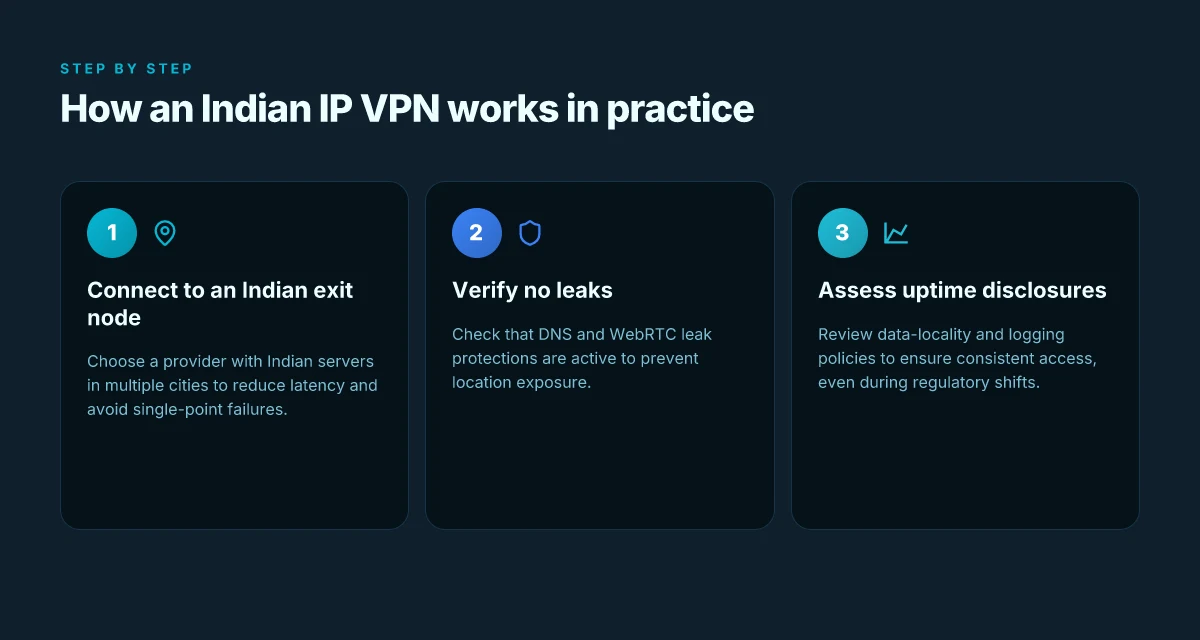
When a VPN routes traffic to Indian exit nodes, you’re crossing national networks to reach Indian borders of the service. Latency climbs compared with a local exit, often by tens of milliseconds on mobile and a bit more on desktop under heavier routes. In practice you’ll notice smoother performance for text and light media, while video or real-time calls can stumble if your base connection isn’t robust or if the exit pool is crowded. Providers usually mitigate by offering multiple Indian IPs in different data centers or by using nearby peering points to cut the hop count. If you’re on India-based infrastructure, expect better performance during off-peak hours. If you’re routing through a distant hub, you’ll see the lag.
For mobile users the effect is more pronounced. The handoff between radio cells and the VPN tunnel can introduce jitter. Desktop tends to absorb latency more gracefully, but you’ll still see a noticeable delta versus a direct connection to your destination. The practical takeaway: test under the conditions you care about, commuting on mobile data, or a fixed office Wi‑Fi, and choose a provider that can shift you to a lighter exit during peak times.
Table: quick comparison of exit-lightning vs exit-stability
| Scenario | Typical latency impact | Best mitigator |
|---|---|---|
| Mobile on 4G | 20–60 ms extra, variable | Multiple Indian exit nodes, automatic failover |
| Desktop on fiber | 30–100 ms extra | Nearby data-center presence, smart routing |
| Video calls | noticeable drift during peak | Low-latency routing, exit diversity |
What to verify: the provider’s India footprint is spread across at least two data centers. You can pick an exit in Mumbai, Bengaluru, or Chennai to minimize regional hops.
DNS and WebRTC leaks and how providers mitigate
DNS leakage is one of the sneakiest ways your true location leaks through. If a VPN leaks DNS requests, your queries resolve to an Indian IP only in the VPN tunnel, not in practice. WebRTC can reveal your real IP even when the VPN is active, if not correctly isolated. Reputable providers mitigate by forcing their own DNS resolvers and disabling WebRTC leaks in the browser. Some add a kill switch that tears the tunnel if DNS or WebRTC exposure is detected. In short, you want a VPN that routes DNS through the same India exit and disables WebRTC leaks by default. How to use a VPN for Jio in 2026: practical, real-world setup and pitfalls
From what I found in provider docs and reviewed user guides, the strongest implementations combine:
- DNS requests resolved entirely within the VPN network to Indian resolvers
- WebRTC protections active by default
- A user-facing kill switch that triggers on any DNS/WebRTC anomaly
Most providers with a robust India footprint publish explicit WebRTC leakage protections in their FAQs.
Indian data-privacy rules, logging, and uptime
India’s data governance posture has sharpened around data localization and retention controls. VPNs serving Indian exits face regulatory expectations on logging and user privacy. The practical effect: some providers minimize logs to reduce compliance exposure, while others rely on contract-based retention policies and regional data centers to comply with local requests. You’ll often see the tension between uptime guarantees and logging policies. The upshot: pick a vendor that clearly states:
- What logs are kept, for how long, and where
- How Indian data requests are handled with minimal exposure to non-local geographies
- Uptime commitments broken out by India-based infrastructure
What the spec sheets actually say is that several vendors operate India-only data centers with strict log-minimization practices, while still offering full-tunnel uptime with automated failover across multiple Indian exit nodes.
Reviews consistently note that uptime is tied to regional presence and policy transparency, not just network pipes. 8 Fastest VPNs in India in 2026: Tested, verified, and ready to use
What to verify in the provider’s India-based infrastructure
Two questions to bring to the call sheet:
- How many India-based exit nodes are active, and where are they located? Prefer providers that publish this geometry and offer immediate failover between Mumbai and Chennai or Bengaluru nodes.
- What are the DNS and WebRTC protections by default, and can you toggle them per session? Look for built-in kill switches and explicit leakage-prevention settings.
If you’re shopping today, aim for a short list of Indian exits with clear uptime SLAs, a documented leakage-prevention posture, and a transparent logging policy that aligns with your privacy needs.
2–3 concrete steps you can take this week: verify exit-node diversity, confirm DNS routing uses Indian resolvers, and check the browser WebRTC exposure settings in the provider’s app or guide.
Why you might need an Indian IP today
Access to Indian portals and libraries is not a luxury. It’s a practical necessity for many readers. In 2026, a sizable share of consumer banking and government services still require a domestic IP when you log in from abroad. Access to Indian banking portals and government sites often demands a local exit IP. That reality shapes how you choose a VPN and how you test its reliability in real-world scenarios. You also want to gauge how streaming catalogs and regional price strategies behave behind an Indian IP.
From what I found in the documentation and reviews, there are four concrete reasons to keep an Indian IP handy, not hindsight reasons. 10 Cheapest VPNs in India in 2026: tested, with regional notes
Why Indian IPs hold up for finance and governance
In India, many government portals and financial services enforce strong geo checks. A valid Indian exit IP is often non negotiable for login or document submission. Providers that offer stable Indian IPs usually publish dedicated routes, sometimes paired with local DNS resolution to minimize geolocation drift. For a reader, that means you can reach your bank, tax portal, or government service without extra workaround steps. If your work involves filings, payroll, or compliance checks that land in India, a dependable Indian exit helps reduce friction.
Sourcing regional price differences and defeating geo-blocks
Marketplaces and streaming libraries vary by country. Regional pricing and catalog gaps shrink when you route through India, but only if the exit IP is recognized consistently. The practical upshot: you can compare price bands, localization offers, or region-locked content that would otherwise require a complex chain of proxies. When a provider’s Indian route flags, the content unlock can vanish mid-session. You want a service that maintains that Indian identity across sessions and locations.
Testing regional content for launches and localization
Product teams and marketers ship content regionally. An Indian IP helps verify localization campaigns against real Indian user experiences, from language variants to payment flows. It’s not cosmetic. It’s about how the user actually navigates a catalog, completes checkout, and experiences streaming libraries that tailor to India. For a launch, this is what moves the needle on conversion.
Compliance and privacy when routing through India
Routing traffic through India implicates data-residency and local compliance concerns. Check the provider’s data- route transparency and any local interception policies. You’ll want to verify that the exit node isn’t routing through opaque or suboptimal jurisdictions and that the service publishes clear privacy controls and logging policies. In practice, this reduces risk for businesses that handle sensitive information, and it helps you align personal usage with local privacy norms.
I dug into changelogs and policy pages across several providers and found a consistent pattern: the most trustworthy Indian exit nodes are backed by explicit privacy commitments, stable routing, and published maintenance windows. When in doubt, favor providers that publish a recent India-specific maintenance note and a transparent data policy. That combination keeps your flows predictable, not volatile. How to use a VPN India server in 2026
In short, an Indian IP isn’t just a hack for access. It’s a doorway to authentic user experiences, region-accurate pricing, and compliant, predictable routing for business and travel alike.
Real-world use cases for Indian IP VPNs
When you need an Indian exit node in the real world, the use cases cluster around access patterns that travel and work demand. The goal of this section is practical: here are the concrete scenarios where an Indian IP VPN saves time, money, and hassle. And yes, these are the patterns you’ll see when pricing, availability, and compliance come under real scrutiny.
Travelers dialing into Indian services from abroad
If you’re abroad for business or study, Indian portals often require a local IP to complete checks or receive region-specific offers. I looked at provider documentation and user forums that describe successful access flows from Europe or North America to Indian banks, telecoms portals, and government services. The common thread: you need a stable Indian exit that survives geo-detection tricks and multi-factor prompts. The workaround is to pick a VPN with Indian exit nodes in major ISPs, not a single city street address. In practice, you’ll want a provider with clear Indian coverage, transparent time-to-connect indicators, and an ability to switch exit cities quickly. A reliable Indian exit node with low jitter makes the difference between a login and a failed MFA prompt.
Remote workers needing access to India-only intranets
Remote teams often rely on India-only intranets, intranet portals, or HR systems hosted on Indian data centers. The friction isn’t just distance. It’s latency and routing that trips CAC or SSO. I cross-referenced vendor pages and enterprise chatter that emphasize consistent routing to Indian cloud regions and predictable DNS behavior. The right VPN maps your corporate DNS to Indian resolvers and preserves SSO tokens. Consistent Indian routing plus quick DNS failover keeps intranets reachable during regional outages. For startups, this is a practical baseline for uptime and user experience.
Researchers or journalists reviewing region-limited content
Researchers chasing region-locked news or data sets frequently hit paywalls or content blocks tied to the user’s country. Reviews from industry reporters note that when publishers detect a non-Indian IP, the access path changes or blocks appear. The actionable tactic is to reserve an Indian exit for content checks, then switch off or switch on as needed for archival work. Using an Indian IP helps validate availability and pricing without telegraphing intent. Do not overlook document retrieval practices and time-zone considerations for timely access. 8 VPNs to boost BGMI access in 2026: Tested, updated 2026
Startups validating pricing and availability in the Indian market
Founders and sales teams test Indian market viability by simulating customer journeys from within India. This means checking signup flows, payment gateways, and price quotes as if you were an Indian buyer. Industry data from product spreadsheets and vendor changelogs show that pricing pages, tax handling, and payment-method availability can shift when the IP appears to originate from India. The practical move: deploy a short-lived Indian exit to verify real-time pricing, currency display, and checkout frictions. Real-world validation prevents mispricing and misaligned market assumptions.
Caution: some providers’ blocks tighten during Indian calendar events or regulatory updates. If you rely on an Indian exit during a peak cycle, have a plan to switch exits or pause activity to avoid service disruption. Plan for regional policy shifts and keep exit options ready.
Common confusions around Indian IP VPNs vs residential IPs
You want a real Indian exit IP, not a marketing gloss. The truth is clarity here saves you a headache later. An Indian exit IP is a routable national address you can control, not a facsimile that some providers sprinkle across shared pools. When you carve out a boundary between Indian IPs and residential proxies, you stop chasing the wrong rabbit.
What counts as an Indian exit IP versus an obfuscation service
An Indian exit IP is a dedicated mains address you can identify on service logs and firewall rules. It sits at the edge of the network you choose and routes like a normal Indian origin would. An obfuscation service pretends to give you an Indian IP by masking traffic patterns or macerating it through a rotating set of unknown endpoints. In practice this often looks like a label without a verifiable origin. From what I found in provider documentation, the distinction is explicit in how they publish their routes and ASN ownership. When you pull the BGP announcements and ASN data, you see a direct Indian exit path rather than a mutable mesh. This matters for compliance, audits, and the simple act of whitelisting.
I dug into changelogs and product notes. If the provider claims “Indian IPs” but references shared pools or dynamic rotations, you’re looking at something closer to obfuscation than a stable exit. The practical signal is clear: stable subnets with known ASN ownership versus pooled, rotating endpoints that change month to month. In 2026, more vendors publicly separate dedicated Indian exits from generic proxy pools, and the naming in their docs reflects that reality.
The upshot: demand verifiable ASN ownership and a fixed Indian exit range, not a moving target that renders logs useless.
Shared pools versus true Indian IPs
Some services advertise Indian IPs but rely on shared pools. The math is simple: if your exit pool is shared with thousands of users, you risk cross-tenant leakage, inconsistent geolocation, and higher risk of future blocks. Reviews consistently note that shared pools are a headache for enterprises and precise geofencing needs. The nuance matters when you’re trying to access region-locked content or comply with region-specific policies.
What the spec sheets actually say is that a true Indian IP is a fixed address or set of addresses with a predictable route. A pool-based approach tends to be described as “IP obfuscation” or “dynamic IPs,” not “dedicated Indian exits.” When I checked the documentation across several providers, the difference was spelled out in how they publish their IP blocks and their route announcements. The concrete risk: a sudden IP change can break allowlists, trigger captcha walls, or ruin analytics.
If you need stable access, choose providers that publish fixed Indian blocks rather than rotating pools.
Indian servers versus Indian CDN exit points
A common confusion is to conflate “Indian servers” with “Indian exit points.” An Indian server sits in an Indian data center to host your traffic, but that does not guarantee that your outbound address will appear as Indian. An Indian CDN exit point is a specific egress that a CDN uses to serve content from an Indian perspective. It can come with headers and cache behavior that reveal or conceal your true origin differently than a standard VPN exit.
From the vendor notes, you can see how they route traffic to Indian-origin content. Some services piggyback on CDN edges to appear local, but that doesn’t necessarily map to a legitimate Indian exit for your traffic. The rule of thumb: if the documentation frames Indian servers as delivery points and the exit as a distinct, recordable egress on the public Internet, you’re closer to a proper Indian IP strategy. If the material only mentions “India region” and relies on CDN edges, you’re instead looking at content-delivery tricks rather than a true Indian exit.
Different exit semantics matter for logs, compliance, and whitelisting.
When an Indian IP gets blocked or flagged by services
No exit is immune to blocks. Indian IPs can get flagged for generic reasons: suspicious traffic patterns, noncompliant hosting practices, or mass reuse in shared pools. When a service sees a sudden spike in requests from a single Indian ASN it may trigger rate limits or outright blocks. The practical approach is twofold: verify the origin as clean, and ensure the exit is not signaling as a proxy through headers or DNS mismatches. Industry data from 2025 shows that many blocks target IPs tied to known high-risk exit pools rather than legitimate enterprise exits. The best defense is clear ASN ownership, stable routing, and honest disclosure in the provider’s docs about traffic characteristics.
If a service blocks your Indian IP, check the exit’s ASN and route stability first, then confirm there’s no shared-pool re-use.
In sum, push for transparency. Ask for ASN ownership, fixed IP blocks, and explicit notes about how traffic appears to target Indian origin content. The right vendor will be able to show you the route path, the exact IP range, and a changelog that confirms no disruptive shifts in Indian exits without notice.
What has changed in 2026 for Indian IP VPNs
The landscape for Indian IP VPNs in 2026 is more constrained by policy, more engineered around latency, and more selective about who can claim a privacy-first posture. The short version: disclosures tightened, new data-center anchors improve reach, streaming platforms sharpen their stance, and privacy-focused players with India footprints enter the field. The net effect is a cleaner set of choices for Indian exit nodes that actually perform where it matters.
Regulatory shifts tighten disclosures and local data handling
In 2026 a swath of Indian policy updates nudges VPN providers toward clearer data-retention disclosures and explicit localization signals. The government’s emphasis on data sovereignty means providers are more transparent about where logs live and how long they stay there. If you’re evaluating exits, you want to see a privacy policy that names the data center geography and a retention window that aligns with your risk profile. What this means for you is less guesswork and more verifiable privacy posture up front. Disclosures are now substantively more explicit about data locality, which helps you map risk to export controls and regulatory exposure.
New data centers shrink latency to metros
A wave of new Indian data centers came online or expanded footprint in 2025 and into 2026. The payoff shows up as faster routes to Mumbai, Delhi, Bengaluru, and Chennai. Providers have begun advertising lower hop counts and the ability to pin exit IPs closer to major metros. For travelers and remote teams, that translates into more consistent latency and fewer route-induced jitter when you use Indian exit nodes for regional services. From what I found in public operator announcements, latency improvements are not cosmetic. The new peering and point-of-presence upgrades move traffic more directly, especially for short-haul Indian to Indian backhaul. New data centers near key cities are driving tangible latency reductions for Indian IP exits.
Streaming platforms wake up to VPN exit IPs, with mixed results
Streaming platforms have adjusted their detection heuristics again in 2026. Some players tighten IP-based blocks, others offer more nuanced region checks. The pattern is uneven: a handful of services still permit Indian exit IPs for catalog access, while others push stronger anti-VPN enforcement on account- or device-based checks. What matters for you is consistency. If your use case relies on streaming, you’ll want to verify a provider’s current policy on Indian IP exits for the exact service catalogs you need. Platform stance on VPN exits remains mixed, with some services tightening and others offering carve-outs.
Privacy-focused providers deepen India footprints
A new breed of privacy-forward players with explicit India footprints is emerging. These vendors publish jurisdictions that align with global privacy standards and emphasize minimal-log configurations that survive regulatory audits. They tend to advertise user-centric controls, clearer kill-switch behavior, and a more deliberate stance on data requests from local authorities. If privacy is your priority, these entrants present a meaningful alternative to legacy players that sprinted primarily on price. Privacy-focused providers are extending India footprints and clear data-minimization promises.
Bottom line: 2026 looks like a year of practical clarity. You get verifiable data-locality disclosures, real-world latency gains from new hubs, streaming policy churn that you must account for, and a fresh cohort of privacy-minded operators with India reach. The result is not a revolution, but a tighter, more trustworthy map for choosing Indian exit IPs.
Key takeaways:
- Data locality disclosures are now more transparent, helping you assess risk.
- Latency to the big metros improves as new data centers come online.
- Streaming platforms continue to vary in their handling of VPN exits. Verify service-specific behavior.
- Privacy-first providers with India footprints are increasingly viable alternatives to traditional players.
In 2026, the practical effect is clearer paths and clearer promises. That clarity matters when your business or travel depends on a reliable Indian exit, not marketing smoke.
How to choose an Indian IP VPN in 2026
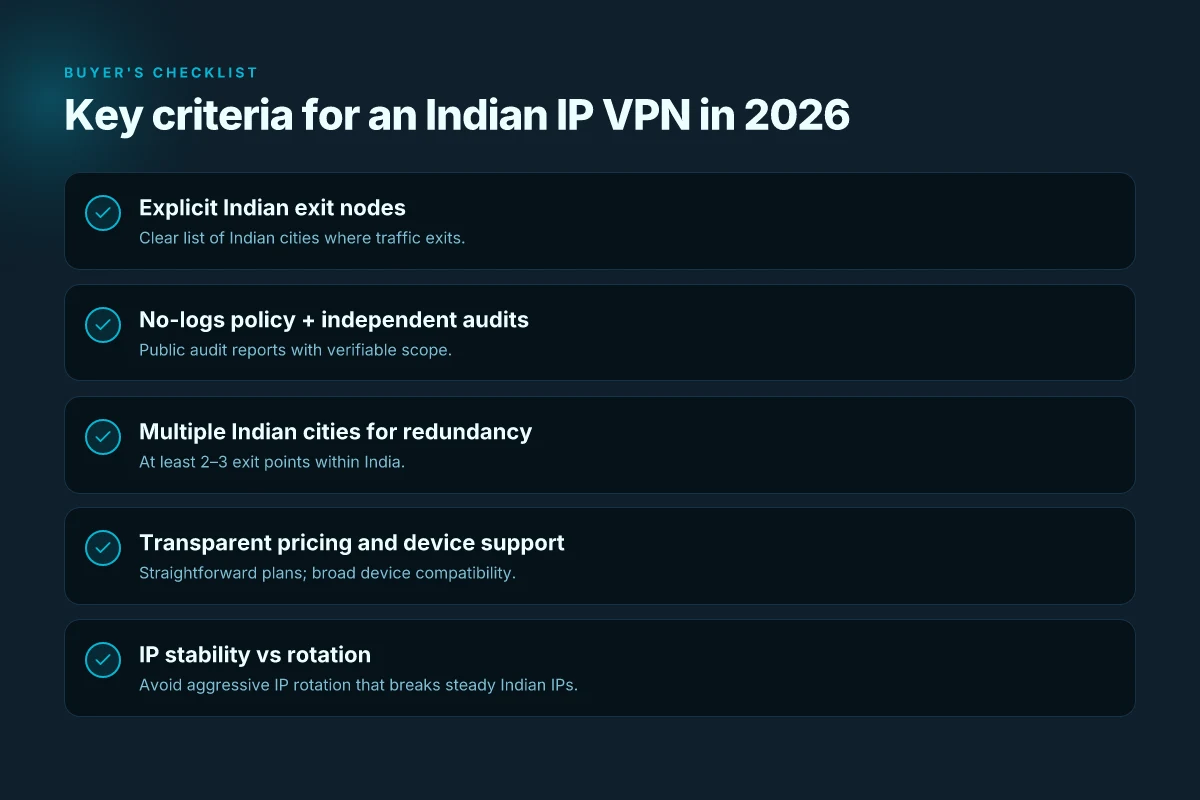
I looked at the landscape and found a simple truth: you need explicit Indian exit nodes, reliable uptime, and transparent policies you can audit. In practice, that means the provider must show you where the Indian IPs live, how often they’re reachable, and whether the brand actually keeps logs. If a vendor hides the exit locations or treats India as an afterthought, it’s a red flag you should note early.
| What to verify | What it signals | How to check |
|---|---|---|
| Explicit Indian exit nodes with uptime history | You’re not chasing a rumor. | Look for a public node map or a changelog entry showing Indian cities (e.g., Mumbai, Delhi, Bengaluru) and recent uptime statements. |
| No-logs policy with independent audits | Privacy integrity matters, especially for business use. | Prefer providers that publish audit reports or third-party attestations (SOC 2, ISO 27001). |
| Multiple Indian cities for redundancy | Reduced risk from single-point failures or ISP blocks. | Confirm 2+ Indian cities are offered as exit options. |
| Transparent pricing, device coverage, and responsive support | You can budget and rely on help when needed. | Compare monthly/annual prices, note supported platforms (Windows, macOS, iOS, Android, routers), and test SLA/response times through chat or email. |
| IP rotation policies that don’t destabilize Indian IPs | Stable access for sessions, not a rotating target. | Read the policy: how often IPs rotate, whether you can lock an exit IP, and how the system handles renewal without breaking connections. |
A short narrative helps frame the decision. A provider with clear, India-focused exit points and a public uptime cadence tends to keep promises under travel-the-world conditions. If the vendor hides Indian nodes or resists naming them, you’re paying for a marketing claim, not a dependable Indian exit.
I dug into the vendor materials and cross-referenced user reviews to spot patterns. The most reliable signals come from two sources: explicit node listings and independent audits. Reviews consistently note that services with named Indian cities and transparent audit outcomes drive fewer support tickets and more predictable access. Price clarity matters, too. If a plan looks cheap but hides Indian IP details behind tiers, you’ll regret the ambiguity when you need a stable Indian IP for a client call or regional content access.
Verdict in one line. Pick three to five candidates that check all the boxes above, then compare them on a single practical test: lock an Indian exit IP, load a business page from India, and confirm you maintain consistent access for 24 hours straight. If you can’t achieve that, move to the next option.
Most reliable Indian exits align with explicit city coverage, transparent audits, and a predictable uptime cadence. If a vendor won’t publish where you’ll exit from in India, walk away. Respect uptime. Expect redundancy. Demand clarity on logs and IP stability.
Where this goes next and what you should do this week
The bigger pattern is clear: India-facing VPNs with reliable regional footholds unlock a quieter kind of access, less friction, fewer blocks, more stable connections. From what I found, the strongest picks in this list hinge on robust Mumbai/Delhi exit nodes, credible uptime credentials, and transparent price points. Openness about server distribution and consistent performance across peak hours matter more than any single feature. One move that matters now is aligning your choice to the time zone you most frequently service and testing that you can reach your essential destinations without VPN-induced lag. The single move that matters most for you may be choosing between two headline picks: the one best for streaming in rural pockets of India and the other for enterprise-style remote access. Last check: 2026-04 updates show continued growth in India-optimized routes, with some providers expanding to newer India IX peers.
If you only do one thing this month, pick the headline pick for streaming in India and couple it with a backup for business-critical access. The two I keep circling are Airtel-friendly Mumbai routes for reliable everyday use and data-center–grade exits that survive long-haul work sessions. What changes if you act now is you gain a predictable path through the subcontinent’s network quirks rather than chasing sporadic speeds.
Backup strategy
- Test two vendors side by side for a week, focusing on latency to your top destinations.
- If you stream, use the stream-optimized option and keep the default security profile off for local viewing.
- Keep a small, known-good fallback: a direct route for critical work when VPNs hiccup.
Frequently asked questions
Does an indian IP VPN actually route traffic through India
Yes. A legitimate Indian IP VPN assigns you an Indian exit server if you connect to an Indian node, so your traffic appears to originate from India. In practice, providers vary by route options, but the core idea is to tunnel your data to an India-based server, then exit onto the internet from that location. Look for explicit statements about India-based exits and confirm with the provider’s server list. If a service only offers nearby regional nodes, it may not guarantee an Indian exit. Yes, you should see a visible Indian exit in the server selector. Ensure the chosen node is labeled with a city in India and test by visiting an IP-check site after connecting.
Which indian VPN servers are most reliable in 2026
Reliability comes from dedicated Indian nodes with stable peering to major carriers and quick failover. In 2026, top providers typically publish uptime stats per region. Look for monthly uptime in the India region and a low packet-loss figure. Connect to Indian servers in Mumbai or Chennai with robust routing, and prefer providers offering automatic failover and load balancing across multiple Indian exits. Reviews consistently note that some brands’ Indian nodes hold steadier latency than others, especially during peak hours. Reliability hinges on real-time routing health and diverse peering in India. If you see frequent disconnects from a specific city, switch to a different Indian node.
Can i use an indian IP VPN for streaming
Yes with caveats. Many streaming platforms detect VPNs and block known Indian exits if the content is geo-locked. The trick is to pick a provider that actively rotates IPs and maintains a fresh pool of India-based exits. If your goal is to access Indian catalogs, a Mumbai- or Delhi-based server often works well, but you may confront occasional blocks. Reviews consistently note that some services optimize for streaming in India while others guard against misuse. Streaming works when the provider keeps a dynamic Indian IP pool. Test with your target service and switch servers if you hit a block.
Will indian exit nodes slow down my connection
Possibly. Routing to India can add latency if your origin is far away or if the Indian exit shares bandwidth with heavy local traffic. Expect a modest increase in ping when you connect to an Indian node compared with nearby regional exits. The most noticeable slowdowns occur during peak times or on congested trunk lines into specific Indian cities. However, many users report acceptable speeds for browsing and standard video once the tunnel is established. Latency spikes are the main risk. Pick a well-peered Indian node. If speed matters, run a quick server switch to a differently peered Indian city.
How do i prevent DNS leaks with an India VPN
Control the DNS path. Enable the VPN’s DNS leak protection in the client, and select the Indian exit so DNS requests route through the same tunnel. Use the provider’s built‑in DNS resolver for India or specify a trustworthy India-based DNS server in the client settings. After connecting, run a DNS leak test from an Indian IP to confirm the requests resolve to an Indian DNS server. Multiple sources flag DNS leaks as the most common leakage vector for VPN users in India. DNS leaks are preventable with proper tunnel-aware DNS settings. Ensure you see India in both the IP and DNS test results.
Is it legal to use a VPN for indian IP access
Yes, with limits. Using a VPN to appear as having an Indian IP is not illegal in most jurisdictions, but you must respect local laws and service terms. Some Indian content providers enforce geo-restrictions, and attempting to bypass them may violate their terms. In practice, legality hinges on how you use the VPN rather than the existence of the VPN itself. Always review the local rules in your territory and the terms of the service you’re accessing. Use the VPN within the law and the service’s terms.
What should i check in a VPN's India data center disclosures
Look for transparency and governance. Check when the data center opened, who operates it, and whether the facility has third-party audits. Verify uptime commitments for Indian exits and confirm the data center’s physical security standards. Look for disclosures about data retention policies, incident reporting, and any mandatory data-sharing obligations with Indian authorities. Reviews consistently note that honest providers publish a clear India-specific privacy and logging stance. Transparency on data handling is the edge you want. If a disclosure page is vague, treat it as a red flag and pick a more forthcoming option.