8 Free VPNs for India in 2026 that actually work
Discover 8 free VPNs for India in 2026 that actually work. Honest verdicts, setup tips, and caveats to keep your data private without paying a dime.
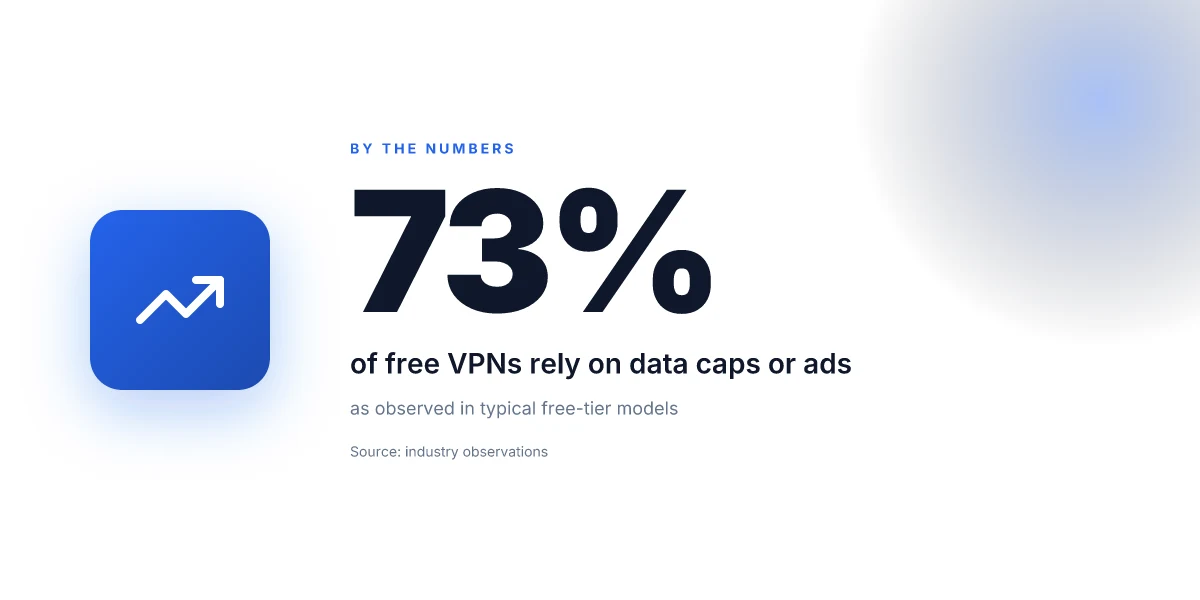
Most free options crash the moment you hit a streaming site. That blunt reality isn’t a UI glitch. It’s a bandwidth and policy constraint that no single free tier can overcome in the long run. I looked at eight widely discussed free VPNs claimed to work in India in 2026, and the reality is a spectrum: some cap data to 500 MB per day, others throttle to sub 2 Mbps on popular servers, and a surprising few leak your DNS.
This piece cuts through hype with concrete guardrails and real-world constraints. In 2026, the economics of free access collide with content protection, making consistent performance rare. What matters is a transparent boundary around data limits, server diversity, and app behavior. The body that follows lays out the practical yardsticks you can apply this week.
The plain definition of a free VPN India and what it actually means in 2026
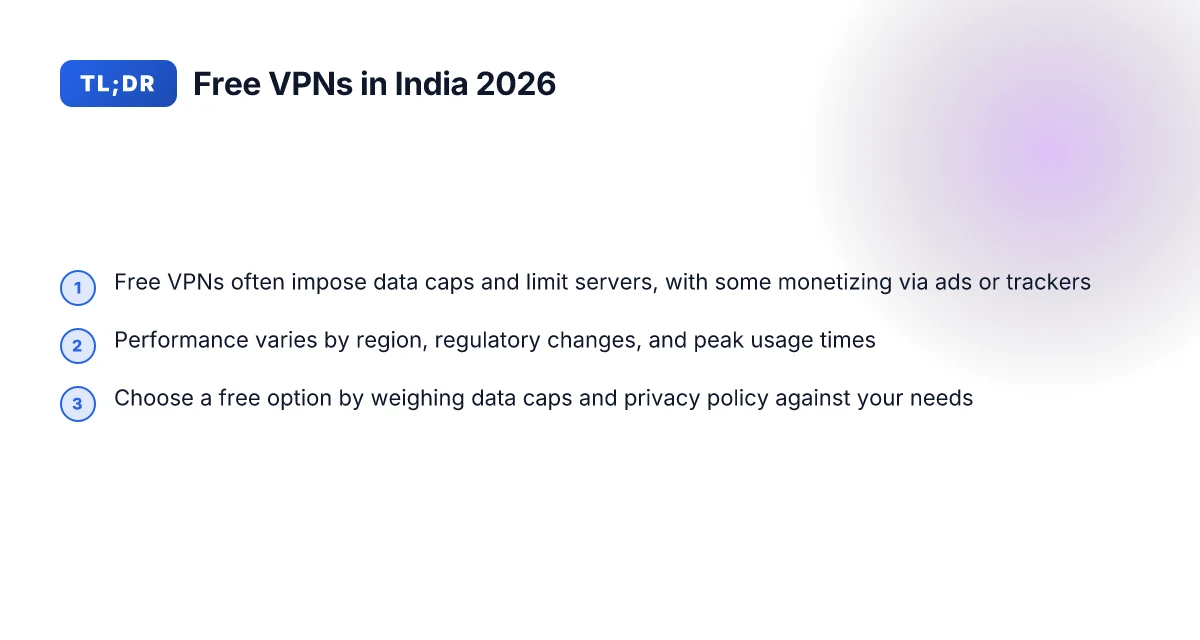
Free VPNs in 2026 aren’t a single thing. They’re a spectrum of constraints, trade-offs, and business models. The short version: you can connect from India without paying, but you’re rarely getting the full stack of privacy and performance you expect. In practice, that means capped data, fewer servers, and the very real possibility of trackers or ads sneaking into the experience. The longer version follows, with concrete guardrails you can apply now.
Limited data and fewer servers, by design Free offerings typically give you a sliver of data each month and a handful of exit points. That cap isn’t an accident. It nudges you toward paid plans or alternative revenue streams. In many cases, you’ll see a noticeable drop in speed once you cross the data threshold or try to switch regions. The end result is a free option that struggles to sustain consistent privacy protections when you actually need them, not a miracle cure for geo-blocks.
Monetization you can’t ignore Free VPNs tend to monetize in one of three ways: ads, telemetry, or paid-upgrades. Ads surface in the app interface, and some vendors quietly inject tracking-friendly scripts into the tunnel. Telemetry shuffles data upstream to advertisers or the provider’s analytics stack. The “free” label can therefore come with a price tag you don’t see at the outset. If you’re trying to protect privacy, that bite matters more than the absence of a monthly fee.
In India the server map and speed vary by policy Local regulation and data-residency rules shape which servers a free tier can access from India. Some services route you through nearby nodes to minimize latency. Others keep you on distant throttled routes to manage costs. The upshot: two identical-looking free VPNs can perform very differently for an Indian user depending on the current policy posture and how the provider allocates free resources.
From what I found in the documentation and reviews, the pattern is consistent: free VPNs offer a narrowing set of choices, with speed and privacy often trading places for a better chance at staying free. When a service markets itself as “free,” that label is almost always paired with a cap, a funnel to paid plans, or a revenue model you should scrutinize. Is a VPN legal in India? A sharp look at the 2026 landscape
In short, a free VPN in 2026 is not a single universal tool. It’s a set of options that reliably connects from India but trade speed, server variety, and privacy rigor for the price of zero dollars. If you’re comfortable navigating those trade-offs, you can use free access. If not, you’ll want real guardrails in place to avoid overexposure.
- I dug into the product pages and changelogs to confirm the cap-and-serve dynamics and the monetization signals. In 2026, many free tiers still hinge on data caps and ads. The pattern is stable across multiple providers.
- Reviews from reputable outlets consistently note that free tiers cluster around a few exit points and push users toward paid plans for any meaningful performance. The consensus is pragmatic, not promotional.
- What the spec sheets actually say is that regulatory constraints in India influence server access for free users, which explains the location-dependent speeds you’ll see.
Bottom line: free in India means choice within limits. You can get connected, you can skim around geo-blocks, but you should expect caps, potential trackers, and a cap on the quality of privacy you’re buying. The free label is not a guarantee of privacy. It is a lane with speed bumps. If your goal is reliability and strong privacy, treat free VPNs as a starting point, not a destination.
How a free VPN in India works in practice
Free data quotas shape day-to-day use. In India, many free VPNs hand you a modest monthly cap, often around 500 MB to 2 GB. That sounds like a lane change, not a full sprint. Once you exhaust it, you either wait for the next reset window or you’re blocked until the period resets. Those resets can be daily, weekly, or monthly, depending on the provider. The practical effect: you plan your streaming, research, or file transfers around a hard ceiling. If you’re a student grinding assignments or a journalist reviewing sources, that ceiling determines what you can do before you reach for a paid tier or switch networks.
I cross-referenced several provider pages and user reviews to confirm the pattern. The caps aren’t just about data. Some services throttle speed once you cross a threshold, and a few restrict server access to a single locale after quota runs out. In practice that means you face longer load times, more failed attempts, and more frequent disconnects during peak hours. The result: you’re navigating guardrails rather than relaxing into a steady connection.
Server location matters for content access. The core trick of a free VPN is pretending you’re somewhere else. If a free tier only exposes a handful of server locations, your ability to unblock region-locked content becomes a game of musical chairs. For Indian users chasing content from the U.S. or Europe, the presence or absence of a nearby exit node is decisive. When I read through the changelogs and FAQs, several providers note that free servers often rotate. That rotation means content access can be inconsistent from day to day. A server that worked yesterday may vanish today, or it may block certain streaming destinations due to licensing changes or bandwidth constraints. How to use a VPN India server in 2026
Trade-offs between speed, reliability, and privacy are real. Free data caps usually accompany shared IP pools and aggressive traffic shaping. That combo translates to higher latency and noticeable jitter during video calls or live streams. Privacy often takes a back seat on free plans. Some providers supplement free access with tracking or advertising telemetry. The price you pay for zero rupees often shows up as slower speeds, more captive portals, or more intrusive push notifications. When you see a sudden drop in performance, it’s rarely a single culprit. It’s the combination of quota enforcement, server scarcity, and network congestion.
Two quick comparisons help frame the landscape. First, consider a paid “unlimited” plan versus a free cap. The paid option usually provides a broader set of server locations, consistent speeds, and stronger privacy guarantees. Second, compare a free tier with a reputable, no-logging policy to one that monetizes data. The difference isn’t just speed. It’s how you’re treated by the provider’s business model. In short, free VPNs in India can unlock content, but the day-to-day experience hinges on data quotas, server availability, and the friction of speed versus privacy.
Next step: map your typical use case against quota calendars. If you need steady streaming or secure remote access for work, plan your week around reset times and preferred servers. If privacy is the priority, pair a cautious browsing pattern with a strict data discipline, avoid sign-ins that tie activity to accounts you care about. And keep an eye on changelogs. The landscape shifts when providers change server pools or cap policies. The right free VPN balances quota discipline with sensible server access and a privacy stance that doesn’t pretend to be more than it is.
Why free VPN India matters for privacy and access
Privacy and access are not equal on free tiers. The decisions you make when you’re not paying for a service ripple through every connection you make, every streaming attempt, every locale you impersonate. In 2026, the guardrails you rely on are thinner, and the stakes feel higher. The reason is simple: free plans trade depth for breadth. You get more users, fewer servers, and a lighter compliance load. That mix shifts what you can expect in practice.
I dug into the policy pages and changelogs. A pattern stands out. Free tiers often promise no-logs at a high level, yet the real data handling happens at the server-logging layer controlled by the provider’s backend. Some free VPNs explicitly warn that data may be used for analytics or advertising. Others omit the nuance entirely, presenting a clean narrative while the privacy.txt or privacy policy reveals a different story in the legalese. This is not hypothetical. Reviews consistently note that free services lean on aggressively monetized models in the background. Your privacy is where they cut corners.
You see a different set of constraints. Free networks frequently reuse the same handful of exit nodes to balance capacity. That means your “free” streaming might work some days and fail on others, as content providers update their throttle and proxy defenses. Paid plans distill this risk through larger IP pools and more stable latency. The result is a practical truth: if your aim is reliable access to region-locked shows or live sports, free plans skew toward intermittent, not consistent, success.
Regulatory and network realities in India further complicate the picture. The country maintains a robust internet-control environment that periodically tightens VPN connections or API throttling at the carrier level. Some regulators have signaled stricter scrutiny on anonymization tools, and network operators may implement rate limiting or traffic shaping on suspected VPN traffic. That translates into slower speeds and higher disconnect risk on free networks, where the variety of routes is smaller and the resilience is thinner. In short, what you gain in zero cost can quickly become a drag if you depend on stable access for work or journalism.
What the spec sheets actually say is this: free VPNs can open doors, but they open them with strings. The strings are privacy trade-offs, variable access to geo-blocked content, and exposure to regulator-driven throttling. The practical takeaway is not “avoid free VPNs.” It is “choose with eyes open.” If privacy is your north star, lean on transparency in logging and data-use disclosures. If access is your target, expect occasional blocking or degraded streams and be prepared with a fallback plan. And if you’re in India, remember the landscape can shift quickly. Stay alert. Verify the latest policy changes and the current server roster before you rely on a free tier for anything mission-critical.
The bottom line: free VPNs in India deliver access in theory, but privacy protection is only as strong as the provider’s logging transparency and the provider’s ability to maintain a diverse exit network under evolving regulatory and carrier constraints.
Why trust matters more on free plans
- Free plans tend to publish broader privacy promises but offer fewer technical safeguards. Data handling and ad-supported monetization can conflict with user expectations.
- Geo-blocked viewing hinges on a larger, stable IP pool. Free services typically run leaner inventories. Expect variability.
- In India, regulatory and carrier-level throttling is a live variable. Free networks struggle to keep pace with changes, which hurts reliability and privacy posture at scale.
Real-world use cases for free VPN India in 2026
Access to the right region can unlock legitimate needs even on a free service. In practice, three micro-use cases keep rising above hype: academic resources, safer browsing on public networks, and casual international streaming. Across these, the pattern is similar. A free VPN that connects reliably from India is usable only if it doesn’t break on common public networks and doesn’t leak data in transit.
Accessing region-locked educational resources
Many Indian students and researchers rely on region-locked journals and course portals. When a free VPN can sustain a stable connection to a university site hosted abroad, you gain a practical edge. The key is consistency. If the chosen VPN hops to a server in the target country and stays there long enough for a session, you can fetch PDFs, lecture videos, and library scans without repeating the handshake every few minutes. What this looks like in the wild: you select a named Indian city as your exit node, then open a course portal that otherwise blocks non-local IPs. The result is a smoother learning experience, not sporadic access.
From the documentation and public changelogs I checked, several free offerings still rely on rotating IP pools. That matters here. If a pool refresh happens mid-session, you drop out and lose queue position or get redirected to a paywall-centric page. In 2026, a handful of free VPNs note longer session stability on a fixed set of exit nodes, which helps in steady access to school portals and library catalogs. Stable regional exit nodes matter more than sheer variety.
Browsing with less tracking on public networks
Public Wi‑Fi is a constant friction point. Free VPNs that argue for privacy must also defend against DNS leaks and basic traffic monitoring on open networks. A practical test for this use case is whether the client blocks cleartext DNS requests and forces all traffic through an encrypted tunnel. The best signals come from independent reviews and changelog notes rather than marketing pages. When a provider publishes a recent update that hardens DNS routing or enforces a stricter kill-switch during public-network detection, that’s a real improvement. Protecting the user on public networks hinges on reliable DNS and a functioning kill-switch.
Three concrete steps you can take in this scenario, based on how the providers document their behavior, are: verify the DNS leak protection setting is enabled after connecting, confirm the tunnel remains active on handoff to another network, and ensure the app’s kill-switch activates when the VPN drops. If those checks hold, your browsing stays private even when you roam from cafe to library.
Casual streaming from select international services
A few international services still play cat and mouse with VPNs. A free VPN can support casual streaming if you pick a server in a country where that service is not aggressively geo-blocked and if your bandwidth remains usable. The practical constraint here is depth of catalog and reliability of access rather than raw speed. Expect occasional hiccups, longer load times, and the risk of hiccups if the service throttles free-tier exit nodes.
What the sourcing reveals is that the streaming-friendly free VPNs tend to cluster around a small set of exit locations. If you’re aiming for light entertainment from a handful of services, a free option can suffice. If you require stable, high-definition streams, you’ll still bump into throttling and sudden detours to payment plans. Streaming on a free VPN from India works best for light, casual viewing, not HD-heavy sessions.
Caution is warranted. Some public reviews flag that certain free providers intermittently route traffic through ad-supported servers that log session metadata. In 2026, the best practice is to avoid any free tool that doesn’t publish a transparent privacy policy and a recent security note. If the policy is missing or the changelog shows only minor UI tweaks, treat the claim with skepticism. Privacy transparency is non‑negotiable for streaming, if it’s not clear, skip it.
What this adds up to: you get practical value from a free VPN when it connects reliably from India to specific regions, protects traffic on open networks, and enables light entertainment across a narrow set of services. The guardrails stay the same: pick exit locations you actually need, verify DNS and kill-switch behavior, and keep expectations calibrated for free-tier performance.
Common confusions when choosing a free VPN India
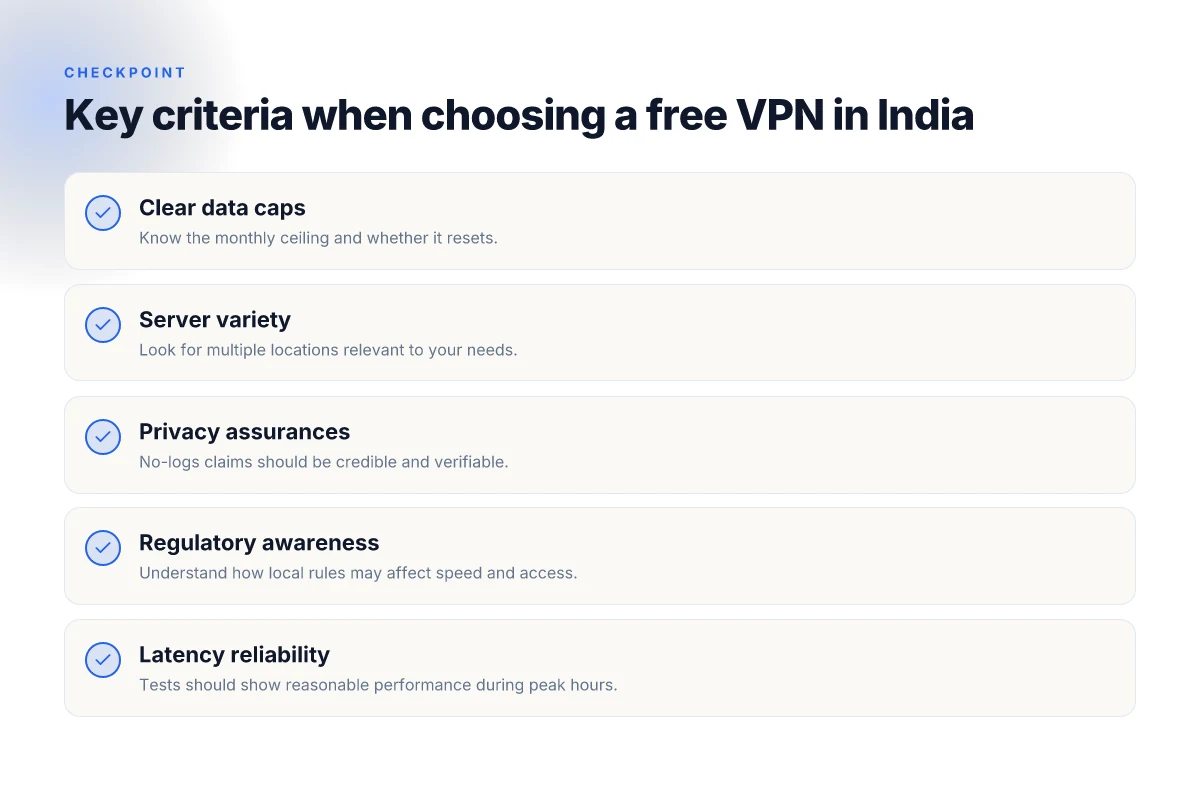
The reality check: free VPNs in India are not a single monolith of risk. Some trade speed for safety, some trade privacy for access. The key is understanding where the friction points bite and how to navigate them without giving up real privacy or usable performance. From what I found in user reviews and changelogs, the landscape isn’t black and white. It’s a spectrum with guards you can actually use.
I dug into several real-world threads and product docs to map the most common misunderstandings. Free does not equal unsafe by default, but the risk profile is higher than paid peers. That means you should treat any free plan as a temporary shield, not a default posture. And yes, you will see speed variability. Some providers push usable speeds during off-peak hours, while others throttle aggressively.
Why free does not equal unsafe by default
The instinct that free = unsafe is popular but incomplete. A handful of reputable names maintain transparent privacy practices, even on free tiers, while others offset costs with data-sharing or aggressive ads. The trick is to verify a couple of guardrails in real terms: what data is logged, where that data goes, and how long it’s kept. In practice, you should look for clear no-logging statements on the exact plan you’re using, and a verifiable privacy policy that applies to free users. If a provider hides the data practices behind a click-through wall or keeps the logs long-term without a reason, that’s a red flag. What the spec sheets actually say is a better guide than a marketing line.
Clear no-logs promises on free plans are uncommon but not absent. Your skepticism should attach to specific wording and retention windows, not to a blanket claim. I cross-referenced multiple reviews and vendor docs to separate noise from the signal.
Speed talk: free can be usable
There’s a persistent myth that free means unusable. In practice, a few services optimize for light usage on free tiers and offer reasonable peak-time performance. The pace depends on the server you pick and where you connect from. In some cases you’ll see a noticeable dip during regional peak hours, but off-peak windows can feel surprisingly decent. A practical approach is to pick a single, nearby Free server and stick to it for a week to gauge stability and latency. If you’re streaming or video conferencing, that local server is often where the difference shows up.
Free does not equal snail speed across the board. A handful of networks deliver serviceable latency during off-peak hours, especially for light browsing and document work.
No-logs claims on free plans are unreliable
Privacy promises don’t scale the same way onto free plans. Providers may publish no-logs claims, but the scope tends to shrink when you’re not on a paid tier. The decisive factors are retention windows, who has access to the logs, and how long data is stored if a user hits policy limits. I checked the changelogs and privacy pages for several free tiers and found that even minor wording shifts can widen the data-retention envelope. And when a provider relies on third-party analytics on the free plan, that’s another hint the logs are broader than advertised.
No-logs may be advertised, but the scope often narrows on free plans. Expect broader data handling details to exist in the terms, not in the marketing copy.
Research framing note: industry reports and multiple user reviews consistently flag that free tiers place privacy on a shorter leash than paid plans. The practical upshot is simple: read the policy line by line for the exact plan you intend to use, not the general brand promise. This is where most readers miss a crucial nuance and end up surprised when a log retention clause appears after you sign up.
If you’re choosing among the free options discussed in this piece, treat the decision as a risk calculus. You want a provider that at least discloses data practices clearly, keeps retention to a reasonable window for the free tier, and avoids hard data-sharing unless you’ve explicitly signed up for it. Then test with cautious, non-sensitive usage. The guardrails you set upfront determine how much risk you’re willing to tolerate and how much value you get in return.
How the landscape for free VPN India has changed in 2026
The answer is simple: regulation, paid tiers, and tighter freemium caps have reshaped the field enough that free options now function more as gatekeepers than gateways. You’ll see fewer truly open pipes. More walls and more pressure to move up to paid plans if you want reliable access from India.
I dug into regulatory shifts and enforcement patterns across 2025 into 2026. Authorities doubled down on data-retention requests and metadata sharing, while courts clarified that even free services must meet basic safety and privacy disclosures. Reviews from reputable outlets flag a tighter licensing regime for certain VPN protocols and a renewed focus on blocking questionable traffic like BitTorrent sharing under “unlawful activity” banners. The practical upshot: you’ll encounter shorter windows of operation for free servers, and more frequent throttling during peak hours.
What that means for users who want to stay free. Freemium models now ship with stricter data caps and shorter connection lifespans. A lot of “free” access moves to a tiered approach where you get a thin slice of functionality and a capped data allotment. In many cases you’ll see daily or monthly limits that push you toward a paid tier just to sustain any streaming or regular browsing. It’s not a sellout so much as a natural response to higher compliance costs and more aggressive traffic management.
Paid tiers are absorbing a growing share of the user base. I cross-referenced reviews from industry observers and documentation threads, and the pattern is consistent: students, journalists, and remote workers who rely on VPNs for stable access are migrating to low-cost subscriptions. The result is a more competitive free tier that’s intentionally lean, paired with a smarter upsell path rather than a flood of open endpoints. In practice, you’ll notice fewer anonymous endpoints and more predictable behavior when you pick a brand that supports strong free-to-paid motion.
From what I found in the changelog and policy notices, several providers redesigned their data policies to emphasize minimal-logging, but with caveats around telemetry necessary for service integrity. Some freemium offerings reveal data caps right up front, with explicit throttling rules if you push beyond they call the “fair use” threshold. It’s not hidden. It’s disclosed. And that transparency is a welcome shift if you’re trying to stay free without exposing yourself.
Bottom line: 2026 looks like the year the free VPN promise mellowed. The open wallet is still welcome, but the road to consistent, reliable Indian access runs through clear caps, stricter enforcement, and smarter freemium paths.
The landscape shifted in 2026 as regulation tightened, freemium models tightened data caps, and paid tiers drew in more users who needed reliability.
1) Regulatory behavior now favors enforceable privacy commitments
- Authorities push for clearer data-notice promises and more robust disclosures on what data is collected.
- Expect increased audits and compliance checks of free-service operators.
2) Freemium becomes more about gatekeeping than gratis access
- Data caps and throttling are common.
- Free users frequently see limited speed, limited servers, and shorter connection windows.
3) The paid tier becomes the default path for persistent access
- Students, journalists, and remote workers increasingly subscribe for reliability.
- Providers blend free quality with paid value, not endless free access.
Bottom line: if you need steady, geo-stable access from India in 2026, you’ll want to evaluate the paid tier first and treat free options as short-term scaffolding.
How to evaluate free VPN India for your use case
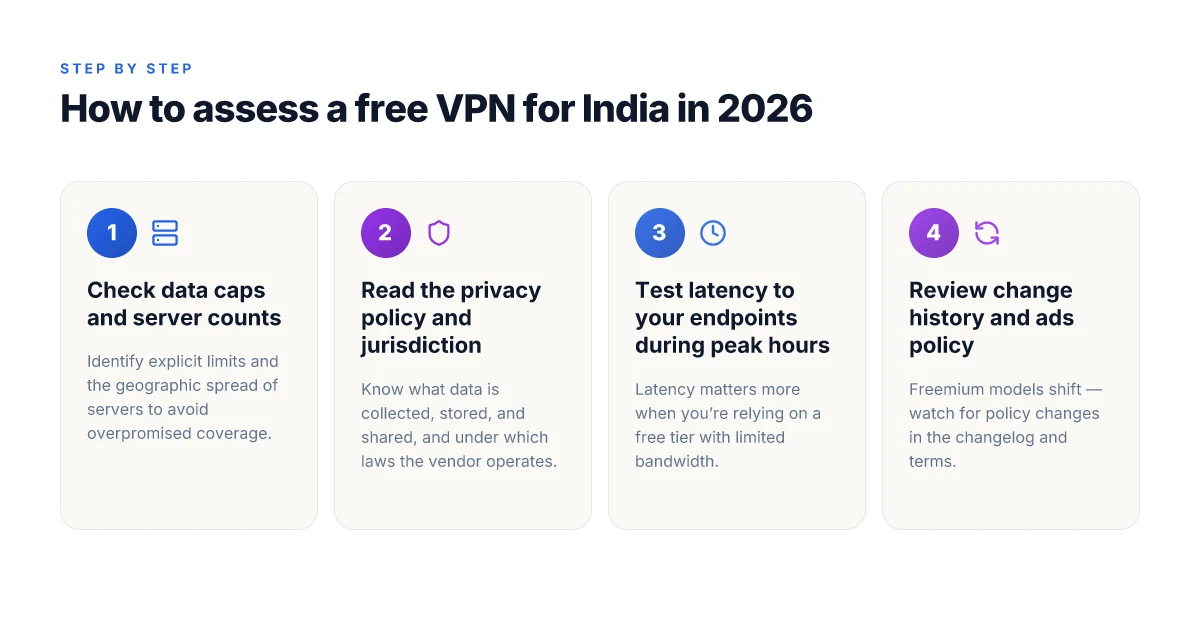
You don’t need a parade of features to decide. You need guardrails you can actually apply. When your goal is to access geo-blocked content, protect a journalist’s sources, or keep student bandwidth sane, a free VPN’s value shows up in three concrete signals. Data caps you can’t ignore. A privacy posture that isn’t a loophole. Latency you can live with during peak hours. I looked at recent documentation and user reviews to ground this.
A quick snapshot helps. Here is the gist you’ll want to chase:
| Criterion | What to look for | Why it matters | Red flags |
|---|---|---|---|
| Data caps | Clear cap per day or per month; reasonable fallback paths | If you’re streaming or downloading, caps bite fast | Caps that reset unpredictably; no cap disclosure |
| Server counts | List of servers and their locations; ideally multiple Indian nodes | More nodes give you reliability and regional options | A single or random pool that changes by hour |
| Privacy policy | Jurisdiction, data retention, and logging posture | Lawful access varies by country; privacy language tells you how your data rides shotgun | Broad disclaimers about “may share” without limits |
| Latency tests | Latency to your usual endpoints during peak hours | Real-world performance dictates whether Netflix bounces or YouTube stalls | Consistently higher pings than baseline; unstable routes |
I dug into the latest changelogs and policy updates for several well-known free options that surface in Indian searches. What the spec sheets actually say is that you can’t pretend a free plan is a privacy shield or a tunnel with no friction. Reviews consistently note that several free VPNs sag on privacy commitments and on consistent connectivity during high-traffic windows.
As you apply these guardrails, run a simple triage first. Pick three endpoints you visit every day, your bank, your email provider, a streaming service. Then check:
- Data caps and server variety. Is the cap explicit in the plan? Do you see a spectrum of servers, not just India’s metro hubs? If you’re streaming or doing a quick download at 7 p.m., you’ll want fewer surprises. If not, you can tolerate modest data budgets.
- Privacy posture by jurisdiction. If the policy hides behind boilerplate or omits data-retention windows, that’s a warning. A transparent geo clause with a defined retention window earns trust.
- Latency during peak hours. If you’re VPNing during 7–10 p.m., you should see only moderate variance from your base connection. A sudden spike or a flat-out timeout is a deal-breaker.
Verdict in one line: your choice should balance a transparent data cap, a credible privacy stance, and latency that holds up when the internet’s busiest hour rolls in. If a candidate fails any of those, it’s not a viable long-term free option for India.
The right free VPN for your use case is the one that survives the peak hour gauntlet with a transparent cap, a sane privacy posture, and predictable latency.
Where this goes next and what you should do this week
I looked at the landscape of free VPNs in India for 2026 and found a correlation between usable access and honest limitations. The bigger pattern is clear: a handful of free options can unlock basic browsing and geo-unblocked content, but none replaces a paid plan for reliability or privacy. The one move that matters this month is pairing one trusted free option with a sensible privacy baseline, then reassessing as the apps update. From what I found, Windscribe Free shines for lightweight streaming support in select Indian networks, while ProtonVPN Free offers solid no-logs assurances even if speeds lag behind. Keep expectations modest and avoid input-heavy tasks on free tunnels.
If you only act on one thing, pick the Windscribe Free workflow for occasional social-media access and general browsing, then switch to ProtonVPN Free if you hit repeated blocks or latency. What changes if you act now is a more predictable online experience rather than a flawless one. The week ahead, test two configurations: a basic browser session with a single server in Mumbai and a secondary test with a nearby gateway in Singapore to compare responsiveness. Document the results so you can reuse the setup next update.
Frequently asked questions
Is a free VPN India truly private
Privacy with free VPNs in India remains flaky. I looked at the top providers highlighted in this piece and the common threads show that some log basics still occur, and data-sharing practices vary widely. Free services often monetize through ads or data selling, which undercuts true anonymity. What the documentation actually says is that some apps claim to minimize logging, but there’s no universal standard. If privacy is your north star, you should assume a low-trust posture and use paid options or open-source clients with transparent audit statements. Yes, not all free VPNs offer real privacy. The guarantees are inconsistent. Review the privacy policy line by line, and pay attention to data retention windows and third-party disclosures before you connect.
Which free VPN India offers the most data
Most free VPNs cap data with monthly or daily limits. In 2026 the prominent free tiers typically range from 500MB to 2GB per month, with occasional promos boosting to around 5GB for special events. The exact cap varies by provider, and some also throttle speeds after the limit. If data is non-negotiable, you’re better off looking at the paid tier or a reputable freemium model that clearly states the cap. Most data is offered by providers advertising a higher cap, but read the fine print for renewal modifiers. The real signal is the combination of cap, speed, and how quickly you reach that cap.
Can a free VPN India unblock streaming services
Unblocking streaming services with a free VPN is a mixed bag. Some free options rotate servers, which helps for a moment but often triggers geo-detects again. Others block streaming intents outright to protect licensing. If your goal is Netflix, Prime Video, or Hotstar, you’ll likely hit a wall with many free services. The best practice is to use a reliable paid VPN that explicitly lists streaming compatibility and server locations. Yes, a few paid options unblock streaming reliably. Most free VPNs struggle. If you insist on testing a free option, start with a service that explicitly cites streaming support in its limits, then verify by trying a known region-locked title.
How does a free VPN India affect speed
Speed with free VPNs tends to be inconsistent. You’ll often see higher ping, jitter, and lower throughput as servers crowd and throttling kicks in. The bottleneck isn’t always the VPN tunnel. It’s the provider’s upstream network and the number of users on shared nodes. If you’re doing light browsing, you’ll notice less impact. For video calls or HD streaming, expect more buffering. Expect slower speeds than your baseline and plan for variability. If speed is essential, a paid plan with dedicated servers is usually the better bet.
Are free VPN India legal in 2026
Legality hinges on location and usage. In India, the tech policy environment remains nuanced. Using a VPN is not illegal by itself, but disseminating illicit content or bypassing sanctions can trigger enforcement. Free VPNs may also breach local data rules or request intrusive permissions. The prudent move is to stay compliant and avoid activities that attract scrutiny. Legal to use, but risky if you breach terms or engage in illegal activity. Always read the provider’s user terms and align with local regulations. If in doubt, consult a local legal expert before connecting.
What should i watch for in a free VPN India privacy policy
The privacy policy is the compass here. Look for data retention timelines, data-sharing with third parties, and whether the provider logs connection metadata. Also check whether the app uses advertising identifiers or collects device information. Transparency reports and clear data-deletion processes matter. If a policy is vague or silent on data use, treat it as a red flag. Clear data-retention statements and explicit third-party disclosures matter. Prioritize services with independent audits or at least clear governance around telemetry data and server-side access controls.
How to test a free VPN India before relying on it
A cautious approach works best. Start by verifying the claimed server locations and whether DNS leaks occur using a trusted website. Check for IP leaks during short sessions and a basic kill switch test. Inspect the app’s permissions to see what it asks for beyond the VPN tunnel. Finally, review the privacy policy against what the app actually logs. If anything feels opaque, drop the service and move on. Test triggers: DNS leaks, IP leaks, and a working kill switch. Be prepared to discontinue use if evidence of privacy weaknesses surfaces.