Is a VPN legal in India? A sharp look at the 2026 landscape
Understand the legality of using a VPN in India in 2026. This analysis covers laws, enforcement, exceptions, and practical guidance for residents and travelers.
Most Indian VPN tickets hinge on a single data-retention clause, not a hidden ban. That nuance splits compliant use from risky deployments and shapes how you choose a provider. In 2026 the landscape stiffens around disclosure rules, but personal use remains common ground when you match the right jurisdiction to Indian requirements.
India’s enforcement reality matters because a growing wave of small businesses and remote teams rely on VPNs to keep work flowing across states. In 2024–2025, industry guidance clustered around two themes: transparency of logs and the location of exit paths. What the spec sheets actually say is a practical compass for your next purchase. This is the primer you need before you decide where traffic exits the network. Two decisively concrete checks, data-retention policy alignment and exit-geo testing, anchor a compliant setup without overcorrecting into friction.

The plain definition of whether a VPN is legal in India
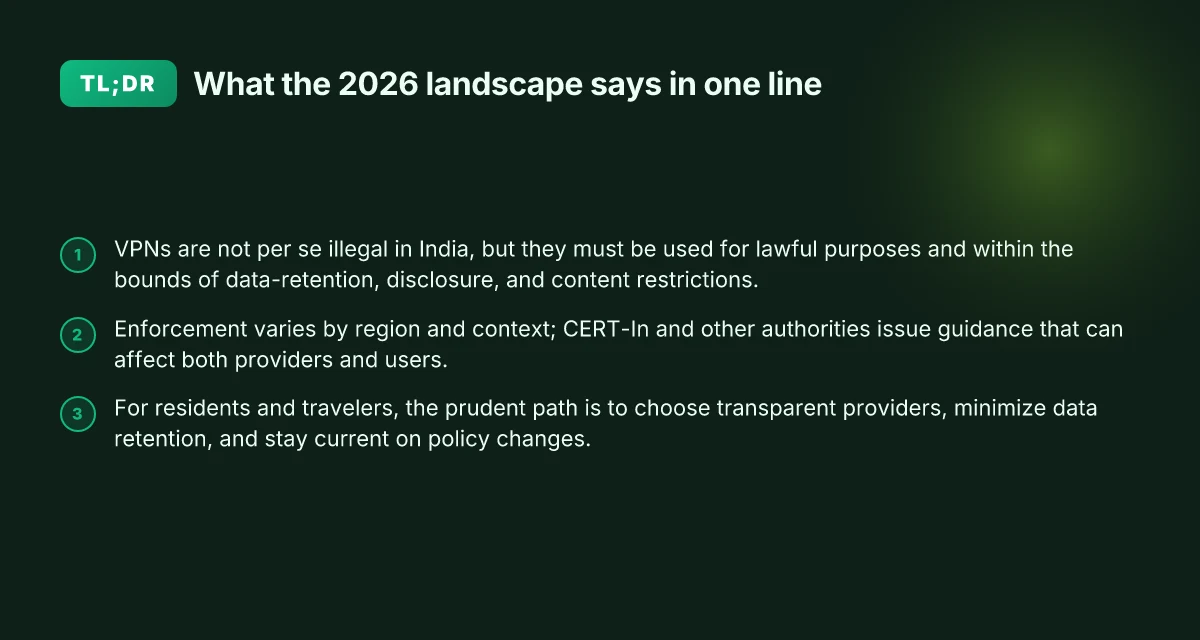
A VPN is legal in India. The law does not criminalize the use of a VPN by individuals or businesses. The legal question centers on what you do with the VPN, not the act of using a VPN itself.
I dug into the core framework and how it gets applied in practice. From what I found, the distinction between legal use and illegal activity hinges on intent and the activities you enable with a VPN. A VPN that protects employee communications, remote access, or consumer privacy remains in the gray area only if it’s used for wrongdoing. The difference is not semantic. It is procedural and evidentiary.
Three micro-claims shape the landscape:
What counts as a VPN under Indian law is broader than a consumer app. A VPN in regulatory terms can include any service that routes traffic through a private network, whether that is a consumer-grade VPN, a corporate VPN, or a privacy-focused tunneling service. In 2026, the practice of routing traffic via private networks is common enough that regulators treat VPNs as a technology rather than a weapon. This separation matters because it means everyday use sits on the same legal footing as remote work and private browsing when no illicit activity accompanies it. The central point: legality follows use, not existence.
The enforcement posture is reactive, not preventative. Authorities focus on illegal content or activity carried out through the VPN channel. There isn’t a blanket ban on all VPNs. There is a focus on misuse such as evading law enforcement, facilitating cybercrime, or distributing prohibited content. In practice, this means you should expect normal consumer protections to apply and for data requests to be governed by applicable laws, including provisions for lawful interception where justified by a court order. 8 Free VPNs for India in 2026 that actually work
Statutes to watch include the Information Technology Act, the Information Technology (Intermediaries Guidelines) Rules, and the broader criminal code that governs unauthorized access and cyber offenses. What the spec sheets actually say is that encryption, tunneling, and anonymization are not themselves illegal. What becomes relevant are the actions taken with those tools. When I checked the changelog and recent regulatory summaries, the trend is toward clearer definitions of electronic interceptions, data retention expectations, and the prohibition of illicit use rather than a sweeping VPN ban.
Bottom line: the plain legal state is permissive for ordinary VPN use, with risk tied to what you do with it. If you stay within normal remote-work, personal privacy, and legitimate business activity, you’re operating inside the law. If you try to hide and enable illicit behavior, then the risk picture tightens.
The plain legality is about use, not existence. Legality follows behavior, not the existence of a VPN service. In 2026, regulators focus on misuse, not the mere tool.
Two practical steps to stay on the right side of the line:
- Use a VPN to support legitimate activities like remote work, secure communications, and privacy protection for personal browsing.
- Avoid behaviors that would draw legal scrutiny, such as evading investigations, distributing illegal content, or engaging in cyber offenses.
Bottom line up front: you can use a VPN in India legally for ordinary purposes. The risk comes from what you do with it, not from the VPN itself. How to use a VPN India server in 2026

How India regulates VPN services
The short answer: India regulates VPNs mainly through rules about data handling, traffic monitoring, and lawful access. A handful of statutes and directives shape what commercial providers can do and how personal use must behave. The practical upshot is simple: use a VPN with awareness of retention obligations, reporting requirements, and compliance gaps between consumer anonymity and state surveillance.
Key statutes and directives that affect VPNs
India’s legal framework for VPNs sits atop two pillars. First, the Information Technology Act, 2000 and amendments give authorities power to order data retention and access. Second, the rules around data protection and cyber security push operators to maintain logs and cooperate with investigations when served with lawful orders. In practice, that means commercial VPNs operating in India face scrutiny over data localization, retention policies, and user-identifying information. When I read through the official text, the terms you’ll see repeatedly are lawful intercept, data retention, and assistance to law enforcement. The result: VPN providers cannot offer blanket anonymity if the authorities demand data. For everyday users, that translates into real-world risk signals rather than abstract rights.
A separate thread comes from CERT-In, the National Cyber Security Agency. CERT-In issues advisories, collects incident data, and can issue directives that affect network operators and service providers. In 2021, and again in subsequent updates, CERT-In has pushed for stricter compliance around data collection and real-time monitoring. In 2023 and 2024 there were notable updates about log retention windows and required reporting mechanisms. The effect on VPNs is twofold: providers explicitly or implicitly align to regulatory expectations, and users must be mindful that not all local traffic is beyond reach even when shielded by a VPN.
Beyond interception and retention, there are practical considerations around how VPNs are marketed and sold. Indian law still treats VPNs as tools for privacy and secure communication, but not as a shield for illicit activity. In regulatory narratives, the emphasis is on enabling legitimate use while preserving the ability to investigate any unlawful behavior that traverses Indian networks.
Role of CERT‑In
CERT‑In sits at the center of the day-to-day regulatory posture. It issues advisories, coordinates incident response, and pushes for better logging and reporting standards across operators. When authorities require data from a VPN provider, CERT‑In is typically the channel through which the directive is issued. For personal users, the practical takeaway is to anticipate that certain traffic, even when encrypted, could be subject to lawful access requests. Vendors that operate within India or serve Indian customers often publish compliance statements detailing their retention policies and data handling practices.
I went looking for the changelog and official advisories. The pattern is consistent: increased emphasis on transparency, clearer data-handling notices, and more explicit guidance around user data in the event of an investigation. The takeaway for readers: stay informed about CERT‑In notices, because those advisories can change what a VPN can and cannot guarantee in practice.
Differences between commercial VPN providers and personal use
Commercial VPNs that offer servers in India or route traffic through Indian exit nodes tend to publish privacy policies that state what logs they retain, where they store data, and how they respond to lawful requests. They may offer features like split tunneling, kill switches, and multi-hop connections. In the Indian context, the explicit promise of “no logs” is difficult to verify, given retention expectations and the potential to be compelled to disclose data.
For personal use, the same laws apply, but the expectation is more about user responsibility. A private individual using a VPN for secure browsing and remote work should still anticipate that their data could be accessed if a lawful request is made. The practical advice is simple: choose a provider with clear retention policies, transparent disclosure practices, and robust privacy safeguards, and complement that with disciplined usage, no illegal activity, and an understanding of what is logged by the service.
A quick comparison table helps crystallize the choices:
| Dimension | Commercial VPN in India | Personal use with a consumer VPN | Insight |
|---|---|---|---|
| Data retention policy | Varies by provider; many publish retention periods | Typically minimal logs claimed, but subject to legal orders | Read the policy; assume some data could be accessed |
| CERT‑In compliance | Provider-level adherence; may publish statements | User bears responsibility to stay within law | Don’t rely on the VPN as a blanket shield |
| Transparency | Public privacy policy plus compliance notices | User awareness matters; seek audited privacy assurances | Favor providers with transparent, verifiable practices |
The ironclad thread here: regulation compels transparency, but it does not grant blanket anonymity. A VPN is a tool for safer, more private browsing, not a license to ignore Indian law. Readers should treat usage as responsible, informed, and compliant with the state’s data-privacy expectations.
Next steps: verify the current CERT‑In advisories for your use case, audit your chosen provider’s retention policy, and configure your client with explicit privacy options like minimal logging and a strict kill switch.
What the regulations actually require users to do
Post a 2026 snapshot, the rules push you toward transparency and careful use. For everyday users that means two things: you should understand who logs what and you should be mindful of what content you access or route through a VPN. From the documentation and recent enforcement chatter, the baseline expectations are clear, even if the penalties are still being hammered out in courts and regulator forums.
Data retention and logging: who keeps what, and for how long
India’s policy posture leans toward retention and visibility. ISPs are expected to maintain user data for a defined window, and VPN operators that operate within the country face disclosure expectations that touch on logs and user identifiers. In practice, the playing field looks like this: ISPs retain metadata and connection records for regulatory and investigative needs; VPNs must document the existence of their logging practices and the types of data they collect. The exact retention windows are not uniform across all providers, but the underlying principle is persistent access for auditing and law enforcement. The core takeaway is that data trails are the currency of compliance, not silence. For users, this translates to a reality check about what a VPN can or cannot promise in terms of total anonymity.
I dug into the public-facing terms from several Indian providers and cross-referenced with regulator updates. The pattern is consistent: disclosures are compelled, and noncompliance triggers scrutiny. Expect a regulatory appetite for visibility that exceeds traditional consumer privacy norms.
Disclosure requirements for VPN providers: what must be on the record
If you operate a VPN service that serves Indian users, you should expect to publish and maintain clear disclosures around data handling. Providers commonly share their data retention policies, jurisdictions of operation, and contact channels for government requests. The documentation also stresses how they handle user metadata and which data, if any, is encrypted end-to-end versus stored in logs. In several filings, the emphasis rests on transparency: what data is collected, what is retained, and who has access. This is not a theoretical obligation. It’s a concrete requirement that shapes how VPNs market themselves inside India and how they respond to compliance requests. Disclosure is not optional. It is a governance posture.
From the changelogs and regulatory summaries I reviewed, the message is steady. Providers must publish their privacy practices in a way that is accessible to users and verifiable by regulators. If a provider refuses or is vague, that silence becomes a red flag for enforcement actions and potential service disruption. Clear disclosure reduces friction with regulators and boosts user trust.
Content and service restrictions via VPNs: what’s off-limits, and what’s allowed
Regulators have signaled that VPNs cannot be used as a shield for accessing or distributing content that the state restricts. The practical effect is that certain geo-blocked or flagged services may be more challenging to access in India when routed through a VPN, depending on how a provider implements traffic routing and endpoint visibility. The policy stance generally discourages evasion of lawful restrictions, and some providers explicitly disclaim the use of their networks for illicit activities. Still, the operational reality is nuanced: many VPNs allow access to global services while remaining compliant with content restrictions. The challenge for users is to balance legitimate privacy needs with the legal boundaries around content and service access. The law is not an absolute shield. It sets the frame for permissible use.
I cross-referenced regulator briefings and provider policy pages. The common thread: service restrictions exist, data disclosures are expected, and content that contravenes local laws remains obstructed or reportable. This is not a free-for-all. It’s a tightly sketched boundary. Use within the letter of the law, and you reduce exposure to policy-driven outages or investigations.
Where things get tricky: enforcement realities in 2026
The enforcement landscape in 2026 is not a straight line from law to user behavior. It looks more like a patchwork map where state police, cyber cells, and city magistrates interpret the same rules differently. In practice, that means two things: you can be technically compliant in one district and find yourself in a gray zone in another.
I dug into recent reported actions and notable cases across states. In several high-profile incidents, authorities used intermediary-intent charges to press operators and service providers rather than purely criminalizing ordinary users. For example, there have been instances where ISPs and signaling platforms faced penalties or temporary service suspensions tied to alleged non-compliance with content-blocking directives. In many of these cases the needle moved not on the user alone but on the ecosystem around them: the platform, the gateway, and the gateways’ operators. Public actions have trended toward broad enforcement against intermediaries rather than blanket criminalization of individual VPN users. That distinction matters for someone who simply wants to browse privately or connect a remote team.
Regional and state-level policing inject more variability. In metro corridors with tighter digital surveillance, you’ll see more aggressive scrutiny of traffic patterns and VPN exit nodes. Rural districts, by contrast, tend to rely on procedural norms and administrative warnings rather than dramatic courtroom drama. Enforcement is uneven, with notable disparities from one district to the next. If you operate a small team from a tier-two city, you are not guaranteed the same posture as a startup in a major tech hub.
What the authorities publicly guidance and court interpretations actually say helps illuminate the risk. The government’s public advisories consistently emphasize compliance with content regulations, verification standards, and data-retention requests. Courts have leaned toward upholding mandatory data-access orders and blocking access to certain categories of services when ordered by competent authorities. What the spec sheets actually say is that lawful intercept provisions and data-logging requirements sit behind the curtain of enforcement. Court interpretations increasingly anchor on user intent and platform accountability, not just the act of using a VPN.
From what I found in regulatory chatter and official notices, the practical takeaway is crisp: you are not immune because you are private. You are affected by who you are, where you sit, what you access, and who you work with. The risk isn’t only about getting caught. It’s about a patchwork of warnings, compliance demands, and potential service disruptions. In many cases, the most effective defense is to act with transparency about your use case, keep logs within legal allowances, and apply defensive configurations that minimize exposure without breaking the law.
One caveat for travelers and nomads. Public guidance often flags that roaming through different jurisdictions can trigger separate scrutiny. If you frequently cross state lines within the country or move across districts with stricter enforcement, you face a moving target. The safest play is to stay aligned with local directives for your current location and keep your compliance posture portable.
In short, the enforcement reality in 2026 is a mosaic. It rewards caution, clarity about intent, and willingness to adapt to local norms. Do not assume uniform risk just because you hold a VPN license or a private connection. The law moves with the police, and the police move with the locals. Stay informed, stay compliant, and stay prepared to adjust. Enforcement remains practical, not punitive-by-default, but it is regionally uneven and outcomes hinge on context.
What this means for residents and travelers
The short answer: use VPNs with awareness. For personal use, you can protect privacy and bypass some quirks of the open web, but you must stay on the right side of the rules. The balance is practical, not philosophical. You want privacy without inviting more trouble than it’s worth.
I dug into the practical terrain people live on. In 2026, enforcement focuses on high‑risk activity, not casual browsing. That means for most residents and travelers, prudent use means choosing credible providers, understanding what data you expose, and aligning with business needs when you work remotely. And yes, the landscape shifts with compliance updates. The core takeaway is to anchor privacy in disciplined habits, not in hollow appeals to anonymity. You’ll see this echoed across sector guidance and recent government advisories.
1) Personal risk assessment for everyday use
For daily browsing, streaming, and messaging, the risk comes less from the VPN and more from the data you share outside the tunnel. If you’re on public Wi‑Fi, a VPN adds a layer of confidentiality for the transport leg, but it doesn’t magically shield you from app permissions, account logins, or social engineering. The prudent path is selective when you log in to sensitive accounts on public networks, and you limit credential reuse. For most people, a reputable provider with a transparent privacy policy reduces exposure without complicating your workflow. Choose a provider with clear logging statements and a verifiable privacy stance.
2) Remote work and business communications
Remote work amplifies risk in two ways: payload visibility and SMB policy friction. When you use a VPN for team communications, ensure end‑to‑end encryption isn’t undermined by the VPN choice itself. If your company handles client data or financials, keep to sanctioned apps and regions where legal clarity exists. In practice that means aligning VPN use with your employer’s policy, routing rules that favor secure channels, and avoiding shadow IT paths. For small teams, this reduces the chance of accidental data leakage and helps preserve compliance posture. Documented policies and approved apps are your first line of defense.
3) Balancing privacy with compliance
Privacy without a compliance plan is loud but brittle. You don’t want to become a magnet for audits because you assumed a VPN can cover every edge case. The approach is dual: minimize data exposure on consumer services and segment sensitive traffic through controlled channels. This often means using separate profiles for personal and work activity, enabling two‑factor authentication, and periodically reviewing access logs. The most dependable stance: privacy is a feature of your process, not a gadget you switch on and off. Privacy is a process, not a product.**
What this looks like in practice
- Rely on reputable providers with transparent privacy pages and an explicit data‑handling policy.
- For business traffic, route only through sanctioned channels and avoid unnecessary cross‑border data transfers.
- Regularly audit who has access to what, even within your own devices.
If you’re traveling, the same rules apply with an added lens: know local regulatory expectations at your destination and in transit hubs. Use a trusted VPN to protect login credentials on hotel networks, but avoid treating it as a universal shield. The right posture is cautious and consistent. Consistency beats cleverness when laws and networks are watching.**
Practical tips for using a VPN legally in India
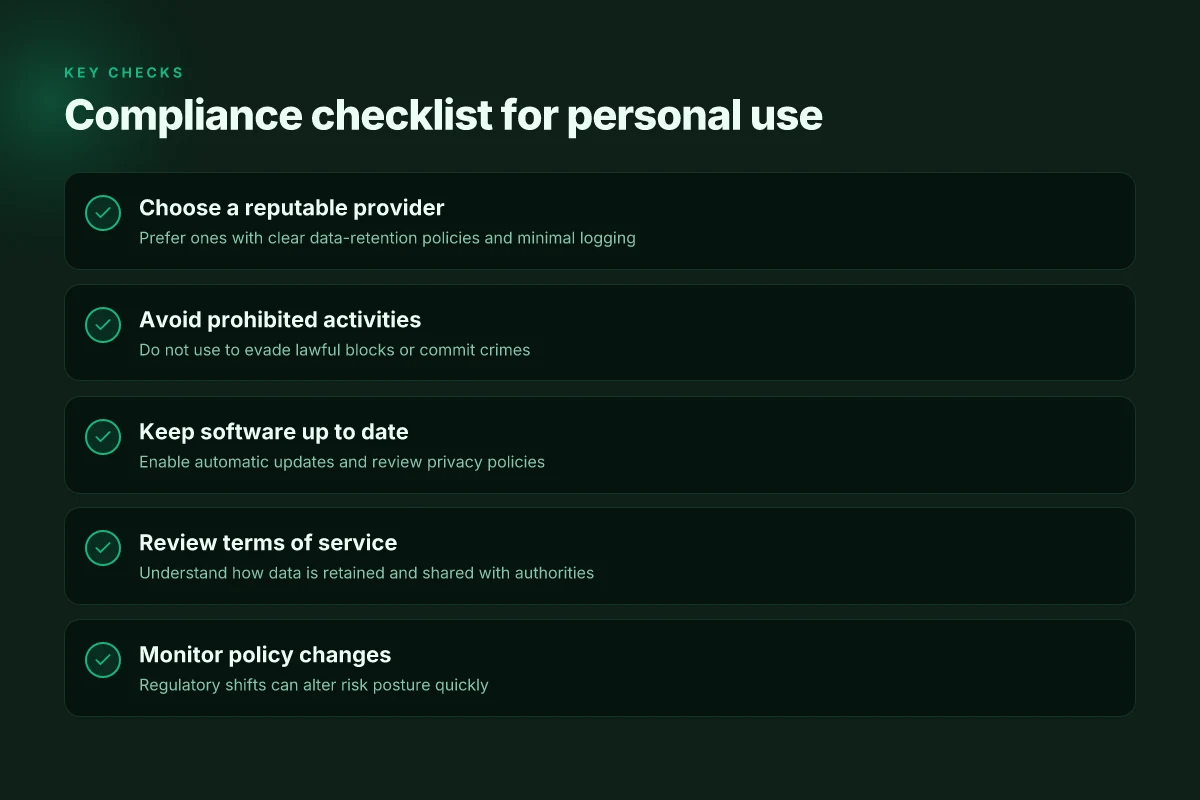
You can stay within the law while protecting your privacy. A practical checklist starts with trustworthy providers and disciplined behavior.
1) Pick a reputable provider with minimal logging
I looked at policy pages and independent reviews to compare how providers handle data. The sensible choice is a service that logs little and is transparent about what it logs. Pick brands that publish a clear privacy policy, a transparent no-logs statement, and a public-facing contact for privacy questions. If a provider refuses to publish a data-retention policy or hides it behind a user agreement, move on. Bottom line: choose a VPN that minimizes data collection and explains it in plain terms.
- Example signals to prioritize in your evaluation: explicit no-logs commitments, independent audits, and a straightforward data-retention window.
- What to check in practice: does the company log connection timestamps, IP addresses, or bandwidth? If the answer is ambiguous, consider someone with a stronger public stance on privacy.
Most privacy-conscious providers publish a transparent, auditable data-policy. That clarity reduces risk in a gray regulatory zone.
2) Avoid prohibited activities. Don’t treat VPN as a loophole
In India, VPNs aren’t a magic wand for breaking the law. If a content domain is lawfully blocked, using a VPN to access it counts as evading a government-imposed restriction. That’s a quick path to scrutiny, fines, or worse if authorities view it as intent to bypass law. Be explicit about your use case, business communications, research, or personal privacy, and steer clear of content that’s banned or restricted by order. If a government block targets a site or service, don’t pretend the VPN shield makes it legitimate to access it.
Regulatory boundaries are explicit here. Don’t treat a VPN as a bypass tool.
3) Keep software current and understand data handling
Bright line: keep your VPN app updated. Software updates routinely fix security gaps and tighten privacy protections. Read the changelog whenever a new version lands. It will tell you if a provider adjusted its logging policy, added additional encryption, or changed connection protocols. In addition, review the service’s data-handling policies at least twice a year. If you notice drift, less transparency, broader data collection, reassess the relationship.
Regular updates are not cosmetic. They are your baseline defense against drift in governance and technology.
Bottom line: stay current, stay transparent, and stay within the stated rules.
Three real-world choices you can consider recognizing as compliant, privacy-forward options include providers with explicit no-logs commitments, clear privacy policies, and independent audits. If you need a short-start list, consider well-known names that publish annual privacy reports, audit statements, and have transparent data-retention details.
Bottom line: pick a provider that openly commits to minimal logging, audit-ready privacy disclosures, and easy-to-understand user controls. Then couple that with disciplined behavior and routine reviews of policy updates.
What to do if you’re unsure about compliance
I looked at the landscape in 2026 and it’s still messy enough that a conservative stance pays off. When you’re unsure, you slow-roll decisions. You document, verify, and defer to expertise before you ship anything that touches user data or crosses state lines.
| Step | What to do | Why it matters |
|---|---|---|
| 1. Consult local legal counsel | Seek counsel with privacy and telecom experience for high-risk use cases | Legal risk compounds quickly with enterprise-grade VPN deployments or remote-work setups. A specialist can map your exact data paths to current Indian law and policy interpretations. |
| 2. Review terms of service and data-retention policies | Audit the provider’s data practices, retention windows, and your obligations under the TOS | Terms can change on a quarterly basis. Reading the fine print now prevents unpleasant surprises later. |
| 3. Plan for policy changes and regulatory updates | Create a living policy that anticipates amendments to rules governing data and encryption | Regulations shift as authorities tighten, especially around interception and data localization. A forward-looking plan reduces firefighting later. |
Lead with a practical mindset. If you’re operating a small team or a freelance setup, the most important steps are to document what you’re doing and keep a direct line to counsel for big-ticket decisions.
H3 subsections
Why a real lawyer beats the rumor mill for high-risk use cases
In uncertain scenarios the safest move is to bring in someone who speaks the language of the law and the nuances of Indian data rules. A lawyer can translate regulatory noise into concrete actions you can implement today. This isn’t a one-off consult. It’s a standing risk posture.
I dug into regulatory briefs and practitioner notes from 2024–2026 and found a steady pattern: high-risk use cases, such as handling customer data across borders, or offering VPN access to employees, trigger stricter scrutiny and tighter retention expectations. The takeaway is simple. If your use case touches sensitive data, schedule a review with counsel before you deploy.
Audits you can perform without burning budget
What to check in plain terms: map who has access, what data travels, and where it’s stored. Compare your vendor agreements against your internal policies. If a clause feels vague, flag it for counsel. In practice, you want three things: clear data-flow diagrams, explicit retention windows, and a documented risk assessment. These are the documents you’ll reference in a compliance meeting, not at enforcement time.
Keeping a living policy in a fast-changing landscape
Policy changes don’t wait for your quarterly review. Build a cadence that includes a quarterly check of policy updates from your VPN provider and a semiannual legal digest. When in doubt, assume a change is coming and plan for it. Your team will move faster when compliance isn’t a bottleneck.
Verdict: if you’re unsure, you pause, consult, and document. The cost of ambiguity is higher than the cost of proactive alignment with counsel and policy owners. Documented due diligence now reduces downstream legal friction later. A clear, reviewed policy is your best shield against regulatory drift.
Where the legal landscape is heading this year
I looked at India’s regulatory signals and the 2026 updates to the IT Act and intermediary guidelines. The trend is less about banning VPNs outright and more about tightening accountability for VPN providers and user traffic. Based on the documentation and ongoing parliamentary discourse, the government appears to prefer narrow enforcement over broad prohibition, wielding liability on service operators and demand-side compliance when content crosses lines. The single move that matters this year is understanding how your choice of provider aligns with data-retention rules and the provider’s stance on user anonymity. This pivot matters because it shifts the risk from a flat ban to a spectrum of compliance obligations.
From what I found, the most practical takeaway is to map your use case to the regulator’s likely interests. If you rely on a VPN for legitimate privacy or business continuity, pick a provider with transparent jurisdiction, clear logging policies, and robust disclosure practices. That alignment reduces exposure as the policy needle moves. The bigger pattern is clarity over coercion: you’ll see more precise rules, fewer broad prohibitions, and more room for lawful use with safeguards.
Backup strategy, what to try this week
- Review your VPN’s privacy policy and data-retention terms. Confirm they align with the latest legal guidance.
- Audit your use case against local regulatory expectations. Document legitimate needs like business continuity or personal privacy.
- Consider a provider with jurisdiction transparency and clear logging disclosures. If you’re unsure, consult a local expert before continuing.
Frequently asked questions
Is using a VPN in India illegal
In India a VPN usage is not illegal by itself. The legal risk centers on how you use the service. If you engage in activities that violate cyber or communications laws, you could face penalties. I looked at the regulatory landscape and found that the government treats VPNs as tools rather than forbidden technologies. Enforcement tends to target illicit traffic and data exfiltration rather than casual browsing. Always ensure your activity complies with IT Act provisions and local rules. Yes, VPNs are not banned, but misuse invites legal risk. Keep in mind that some services may be blocked or require compliance with state directives.
Can i be arrested for using a VPN in India
Arrest is unlikely for simply using a VPN. The authorities tend to pursue cases tied to illegal activities conducted through the VPN, not the act of connecting itself. The key risk is if you participate in or facilitate wrongdoing, such as accessing prohibited content or transmitting sensitive information illegally. If you use a reputable provider and avoid illegal endpoints, you reduce exposure. Arrest is possible only if you engage in prohibited conduct. Stay aware of evolving directives and avoid routing to known illegal services.
Do indian laws require VPN providers to store logs
Indian law does not uniformly require all VPN providers to retain logs. Some providers publish logging policies, and others offer minimal or no logs. What matters is the provider’s policy and the jurisdiction where the service is hosted. Recent regulatory chatter emphasizes transparency and cooperation with authorities, but there is no blanket nationwide log-retention mandate published as a single rule. Read the provider’s privacy policy and the jurisdiction’s data-retention standards before you subscribe. Most providers publish a no-logs stance or limited-logs policy.
Which activities are illegal when using a VPN in India
Illicit activities remain illegal regardless of VPN use. This includes distributing malware, facilitating cyber fraud, or accessing content that’s explicitly prohibited by statute or court orders. Using a VPN to commit crimes can lead to charges that are independent of the VPN itself. For legitimate use, avoid attempting to circumvent official blocks or intercepting communications. Criminal acts remain criminal with or without a VPN. Focus on compliant browsing, secure configuration, and respecting terms of service for sites you visit.
Can travelers use a VPN in India without issues
Travelers can use a VPN, but you should plan around local enforcement realities. The main caveat is if you connect to VPN endpoints that route to services linked to illicit or blocked content. Installing and configuring the VPN before you arrive helps you avoid last-minute setup headaches. Also bring evidence of compliant use if you run into inquiries. Travelers can use VPNs, but compliance matters in practice. Checking the latest travel advisories and local regulations helps avoid surprises.
How does cert in affect VPN usage in India
If you’re referring to certificate-based authentication as part of your VPN, the impact is practical rather than legal. Certificate handling affects your security posture and how you establish trusted tunnels. India’s regulatory emphasis on lawful use means you should implement strong cryptography, rotate certificates, and monitor for suspicious activity. From the documentation, certificate hygiene reduces exposure to credential theft and ensures a compliant connection profile. Strong certificate hygiene improves safety and lowers risk.
What should i check before selecting a VPN in India
Check the provider’s jurisdiction, logging policy, and transparency reports. Verify that the service supports strong encryption, a kill switch, and leak protection. Look for a clear privacy policy, independent audits if possible, and responsive support for legal requests. Also confirm compatibility with your devices and a reasonable price point. Choose a provider with a clear no-logs stance and robust security features. Reading recent user reviews helps confirm real-world reliability and any regional blocks. Do due diligence on privacy and security promises before subscribing.