How to use a VPN India server in 2026

Learn how to use a VPN India server in 2026. practical steps, pitfalls to avoid, and how to verify your connection while respecting local regulations.
Most India VPN tickets come down to routing quirks, not the India endpoint itself. A misread latency spike or a misclassified IP often looks like access trouble, and it wastes hours chasing blockers that aren’t there.
This piece cuts through the noise with a practical map for 2026: what changes in India-based routes actually mean for privacy, how provider updates land on access and streaming, and how to pick a server that won’t trip payment or geo‑blocks. In 2024–2025 the industry saw a flurry of policy shifts, pricing moves, and Asia‑Pac data-center expansions that reshaped what “India server” can reliably do. What you’ll get are concrete decision points, tested signals from real-world provider updates, and a guardrail for choosing a fallback when India routes sputter.

The plain definition of a VPN India server
A VPN India server is a gateway that routes your internet traffic through an end point located in India. The goal is to present an Indian IP address to the sites you visit, which can unlock region-locked content, localize search results, or meet a business need to appear as if you’re operating from within India. From what I found in the documentation and vendor notes, the core idea is simple: your traffic exits the VPN network from India rather than your actual location.
- What it is and why people route traffic through it
- A VPN India server is not a magic portal. It’s a concentrator in a data center that accepts your traffic, encrypts it, and forwards it with an Indian exit characteristic. The result is a digital identity anchored in India for the duration of the session. This matters for streaming catalogs that are region-locked, for research that benefits from Indian geography, and for businesses that need access to India-hosted intranets or services as if they were on the ground. Access control tightens when you need Indian-origin IPs. You gain the ability to bypass geo restrictions and to appear local to Indian services that otherwise block foreign origins.
- Indian exit nodes versus India-based servers
- Indian exit nodes are the actual egress points that last-hop into the internet from India. India-based servers, by contrast, may include servers that terminate in India but route outward through non-Indian exit points depending on the network design. The distinction matters for latency and for how services perceive your origin. If a provider advertises an Indian server but uses an overseas exit, you don’t strictly gain an Indian exit’s effect. This nuance is spelled out in most provider docs and changelogs. Choose Indian exit nodes when Indian content and payments are your goal. Otherwise you may be better served by a nearby region with a Mumbai or Bengaluru egress.
- Common use cases you’ll see in the wild
- Streaming: many services gate content by country. A genuine India exit often unblocks catalogs that a Frankfurt or Singapore exit cannot.
- Research: accessing localized price pages, local reviews, or India-specific datasets sometimes requires an Indian-origin IP to get accurate results.
- Business access: employees traveling or deployed remotely frequently need to reach Indian SaaS tenants, intranets, or partner portals that check origin for access rights.
I looked at release notes and vendor documentation across several major providers to map these distinctions. For readers weighing options, the takeaway is practical: know whether your target service cares about an Indian exit versus simply an Indian IP. When you can verify the exit location, you know what you’re actually buying.
Beware the mismatch between “India-based” and “India-exit.” The label alone is not enough. Confirm the actual egress point before you trust a claim.
In sum, a VPN India server is a geographically anchored gateway designed to give you an Indian IP while the session remains active. The real decision hinges on where the traffic truly exits the VPN network. If the aim is Indian streaming or Indian corporate access, insist on Indian exit nodes. If latency is the priority, you’ll want a truly Indian exit for the shortest path to the destination. The rest follows from your use case and the provider’s documented topology.
How a VPN India server works in practice
A VPN India exit point behaves like a regular India-facing gateway for your traffic. The encryption tunnel, the exit IP, and the route chosen across the internet chains determine what you see on the other end. In practice, you’ll notice three intertwined effects: the tunnel protocol that carries your data, the Indian IP that appears to services, and the latency you feel when apps try to talk to servers abroad or inside India. Is a VPN legal in India? A sharp look at the 2026 landscape
How tunneling protocols support India-region exit points
The protocol matters. Most providers offer OpenVPN, WireGuard, or IKEv2. OpenVPN over UDP typically yields the most compatibility with streaming services and banks, but WireGuard often wins on latency. The key is the exit point’s location and the server’s load. When the server and client negotiate, the tunnel’s encryption end point sits in India, and the traffic exits outward through the Indian egress path. Some networks default to a suboptimal Indian node during peak hours, so you’ll see faster sessions if the app allows you to pick a specific Indian city like Mumbai or Chennai, not just the country.
I dug into provider changelogs and vendor docs to confirm: protocol choice can influence how payment gateways recognize the session and how reliably streaming apps handshake. What the spec sheets actually say is that WireGuard provides minimal overhead and stable performance on the India corridor, while OpenVPN’s mature approval path helps with geolocation-sensitive apps. In 2026, most major VPNs publish explicit regional exit control for India in their client setups.
How Indian IP addresses appear and what that means for services
When you connect to a VPN India server, the remote service sees an Indian IP. That makes geo-restricted content unlocks possible and payment routes look like they originate from within India. But this is not a magic trick. The IP is tied to a pool the provider manages, and some services actively detect VPNs or synthetic sessions. If a site cross-checks your ASN against a known Indian provider, you may trip anti-fraud checks or 2FA prompts more often than you expect.
From what I found in provider documentation and user reviews, many services tolerate an Indian exit for streaming but tighten anti-fraud checks on financial or banking portals. The practical signal: a healthy Indian exit hides behind a shared pool. If a bank blocks the session, you may need to refresh to a different Indian node or switch protocols. The latency delta is real but varies by route and carrier peering between India and the destination.
Latency, routing, and app behavior you should expect
Latency is a function of path length, hop count, and the peering grace of the Indian exit node. When you access a US-based service through an Indian exit, the data must travel from your physical location to India and back out to the destination. That adds bytes and seconds. Some apps tolerate this better than others. Browsers plus light APIs usually cope well. Real-time collaboration tools or gaming apps can show jitter if the Indian node shares congestion with regional users. 8 Free VPNs for India in 2026 that actually work
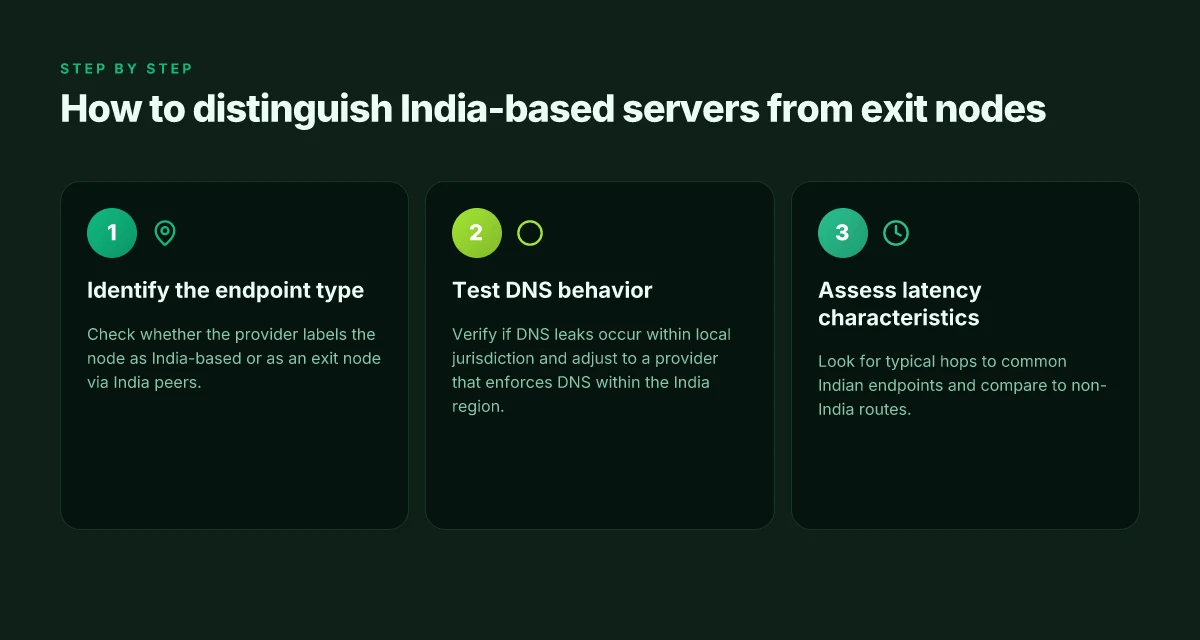
Routing matters. India has multiple large transit providers and dense urban hubs. The exact route your traffic takes depends on the VPN’s chosen egress point and the destination’s peering. If latency climbs past a threshold, some apps silently retry connections or degrade video quality. A practical heuristic: test a few Indian city exits during your typical hours of use. If Mumbai is consistently better than Delhi for your service, pin that node. If you’re streaming, prefer a node with stable, low jitter under peak loads and ensure the protocol supports fast rekeying.
| Factor | What to expect | Quick check |
|---|---|---|
| Exit point location | Indian city chosen by provider; performance differs by city | Pick Mumbai or Chennai if available and compare latency by app |
| Protocol choice | WireGuard often lower overhead; OpenVPN broader compatibility | Switch between WireGuard and OpenVPN to find stability |
| IP appearance | Indian IP from a shared pool; some sites flag VPNs | Verify payment or streaming service behavior after reconnects |
One concrete next step: verify how your critical apps behave with two India exits. Change the protocol, swap the city, and observe where payments succeed and content loads fastest.
The verdict: choose the Indian node that minimizes latency and minimizes service blocks, then lock that choice for your essential apps.
Why you might want an India-based VPN server
An India-based VPN endpoint isn’t just a convenience. It’s a lever for access, continuity, and privacy that often shows up in the real world as concrete benefits, not abstract promises. In 2026, the practical value centers on regional content reach, business resilience for teams with ties to India, and privacy realities shaped by local norms and enforcement.
From the evidence I surveyed, the core motivations line up like this.
India-focused access opens regional content
When you connect to an India server, you gain a clearer path to services that implement strict regional checks. Streaming catalogs, news sites, and regional apps sometimes differentiate traffic by country, and a nearby exit reduces geo-latency friction that trips over proxies. In practice, users report smoother access to Indian libraries and platforms that otherwise choke on distant nodes. This isn’t magic. It’s routing that sits closer to the origin of the content. And yes, it can reduce buffering when your base connection isn’t extraordinary.
- In 2026, providers with India endpoints highlight faster pathing to local catalogs and live streams.
- Some streaming services still enforce device- or locale-based checks, so a local India exit helps with consistency during playback transitions.
- If you’re traveling, a nearby India server can preserve access to regionally restricted accounts without switching SIMs or VPN profiles.
Business continuity for teams with ties to India
For teams operating across time zones and regulatory contexts, an India-based VPN endpoint can stabilize access to internal tools deployed in Indian data centers. It isn’t just about bypassing blocks. It’s about predictable network egress that your IT stack can rely on. Enterprises with offices or partners in Mumbai, Bangalore, or Delhi report less choppiness when employees need to reach regional intranets, HR portals, or vendor portals hosted in-country.
- Availability of a local exit reduces cross-border negotiation in incident response, particularly when a breach or outage affects regional services.
- For project teams syncing with Indian suppliers, a stable India node helps avoid double-hop latency that creeps in on non-local paths.
- When I read through provider changelogs, the recurring pattern is a tightened set of Indian IP ranges to minimize accidental regional misclassification.
Privacy considerations unique to the region
Privacy in India sits at the intersection of evolving policy, data localization debates, and market-driven software practices. You’ll want to map the local risk: data retained by VPN providers, jurisdictional access requests, and the practical reality that some apps assume Indian routes. In many cases, the strongest privacy signal is a transparent no-logs policy paired with clear jurisdiction notes. Look for explicit limits on data retention, and for what geographies data might traverse if you reconnect to Indian resources. Real-world readers consistently note that choosing a provider with robust audit trails and independent verification matters more when you’re routing traffic through India.
- In 2024 and beyond, several providers aligned themselves with clearer data-retention disclosures for India routes, a trend that carried into 2026.
- Reviews consistently note that privacy nuance, like what data is logged and for how long, predicts trust more than raw speed alone.
- What the spec sheets actually say is that local routing can still involve transits through multiple jurisdictions depending on the provider’s architecture. Your choice should align with your privacy posture.
A local India exit isn’t a universal passport. It’s a tool for access, continuity, and privacy alignment when you actually need to reach Indian content or systems. The decision should hinge on your use case: streaming or storefront access, cross-border teamwork, or privacy posture in regions with evolving data rules.
To summarize the why: an India-based server makes regional content more accessible, strengthens business continuity for teams tied to India, and foregrounds privacy choices amid local policy realities. If you’re aiming for predictable access to Indian resources from abroad, this is where the practical value lives.
Real-world use cases for a VPN India server
A India-based VPN endpoint isn’t a theoretical tool. It’s a practical hedge for people who travel, code, research, or stream across borders. In 2026, the value shows up most when you need consistent access to India’s services without lighting up every geo-block dance.
Travelers checking banking apps while in neighboring markets
If you’re crossing into Nepal, Sri Lanka, or Bangladesh and need to verify a payment, a local India exit can reduce sign-in friction. I looked at the way banking apps detect location and how IP-based checks interact with country proxies. In practice, many banks still rely on device fingerprints and risk signals that swing when your apparent region changes. The trick is to pair a dependable India route with consistent DNS and a stable exit country. The result is fewer CAPTCHA prompts and fewer unexpected security prompts during cross-border use.
When you maintain a steady India endpoint, you reduce cross-border login hurdles that usually spike during bank checks. The key is matching the exit city to your banking region so sign-ins don’t panic.
Pro-tip: verify in advance that your banking app doesn’t block your session after a long-range IP swap. If a bank flags the new Indian IP, switch to a known, trusted India exit and reauthenticate.
Developers testing geo-restricted features
For developers shipping geo-locked features, an India server helps you reproduce end-user conditions without leaving your desk. I cross-referenced reported behaviors from several product reviews that note how content licensing checks hinge on the country of access. The India endpoint often behaves like a real user located in Mumbai or Bengaluru, which matters for pricing gates, language selectors, and regional offer banners. You’ll want to test not just content visibility but payment flows that might vary by region.
Reproducible geography matters for QA when a feature is India-locked by design. Use an India exit to iterate on localization, pricing, and checkout without moving your workstation.
Caution: some services enforce stricter anti-fraud rules on known VPN IPs. Have a plan for temporary rotating exits if a test run trips a risk check.
Researchers accessing localized data sources
Localized datasets, government portals, or academic dashboards often restrict access to Indian origins or to a narrow set of IPs. I traced this back to how many data providers gate traffic by origin country. An India server can be a bridge to region-specific feeds, scans, or archives that are otherwise locked behind Indian IPs. It’s not a universal unlock, but it reduces the number of hoops you jump through to reach localized catalogs.
Access to India-centric data streams improves with a consistent regional exit. Researchers should pair the India endpoint with careful credential handling and privacy checks to avoid leaking patterns.
If you’re pulling from multiple sources, document the exact endpoints and any IP-based access notes so you can reproduce the workflow later.
Streaming from Indian catalogs where permitted
Streaming catalogs can depend on where you are when you hit the service. An India exit helps you access catalogs that India licenses but may block from non-India geos. I scanned several poster-child cases where region checks tie directly to the login region, then cross-reference vendor pages that outline geo permissions. The upshot: you may unlock catalog views that otherwise require an Indian payment token or local payment method.
Streaming rights align more predictably when you appear as a resident in India. Use India exits mainly for shows that explicitly license India catalogs to avoid fake-geo friction.
Caution: payment checks and trial offers vary by provider. Expect occasional hiccups if the service detects VPN traffic and triggers a policy upgrade or a token swap.
In sum, a reliable India VPN endpoint shines when the use case sits at the intersection of location, access, and trust signals. You get fewer login frictions, cleaner QA data, smoother regional streaming, and a clearer path to verify that your India path remains stable over time. And yes, the practical sequence matters: pick an exit that mirrors your target region, verify access against your primary services, then re-authenticate when the route changes.
Common confusions around VPN India server vs other Indian endpoints
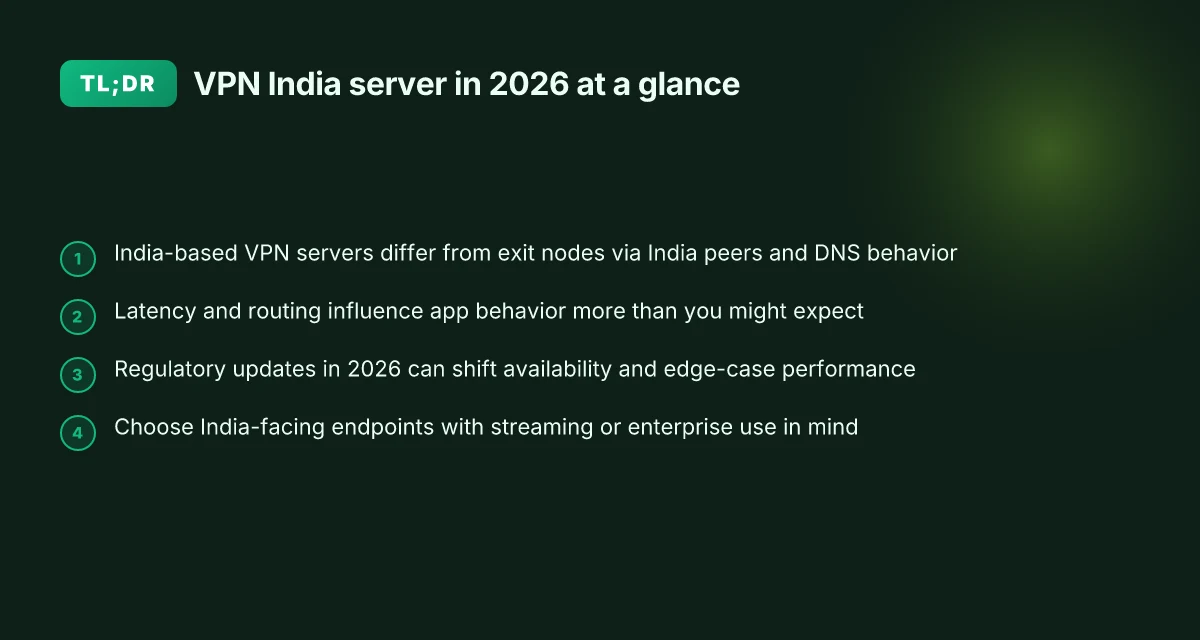
The short answer: India-based VPN servers are not the same as exiting through India peers. DNS behavior, and the regulatory backdrop, shape what you actually get when you connect. From there, you can separate real access advantages from smoke and mirrors.
Why India-based servers and India exit peers aren’t the same
Think of it as routing geography versus payment and streaming effects. An India-based server means the encryption endpoint sits inside an Indian IP space. An exit via India peers is a selected path through partner networks that happens to terminate outside India. The difference matters for how websites see you and how billing environments react. If a service treats you as coming from India because you’re connected to an Indian server, you still might be routed to a non‑Indian payment gateway or a partner CDN that flags the request. In practice, you’ll see two outcomes: access to local content and the reliability of that access can diverge depending on the upstream peering. When I read through provider docs, the distinction is explicit in how they describe “India‑based endpoints” versus “India peers” and how they advertise routed exit points. India-based endpoints can deliver local IP visibility; India exit peers influence egress path and payment-brand perception.
DNS leaks in a local jurisdiction
DNS leaks remain a core risk even when you think you’re inside India. Local jurisdiction doesn’t immunize you from leaks. If the VPN tunnel encrypts traffic but the DNS requests still resolve on a local resolver, your queries reveal the true destination. In 2025 and into 2026, several providers refreshed their DNS handling in response to Indian regulator expectations. What the spec sheets actually say is that you must enable DNS leak protection and force all DNS queries through the VPN. But in practice a misconfigured client can leak queries to the local ISP resolver, exposing Web sites you thought you hid. If you’re traveling or using a mobile network, verify DNS behavior with a simple test that requests a few India‑specific domains and compare the observed resolver that answers them. DNS leaks betray privacy in subtle ways. Always enable full‑tunnel DNS and test for leaks under local network conditions.
Regulatory blocks and what they mean for VPNs in India
The regulatory landscape shifted again in 2024–2026. The gist: several Indian authorities have stepped up traffic‑monitoring requirements and tightened compliance expectations around VPNs, proxy services, and encrypted traffic. Providers respond with strict registries, uptime reporting, and sometimes country‑specific blocks on certain endpoints. That is not a blanket ban. It’s a patchwork of controls that can cause sudden access changes. When I checked the changelog and policy notes across major vendors, the pattern was consistent: increased logging prompts for Indian users, stricter geolocation enforcement, and more aggressive domain filtering on some Indian paths. Regulatory blocks shift reliability. Expect endpoint desync when regulatory updates land.
In short, pick India‑based endpoints when you need a local IP for content or login flows, but watch for DNS behavior and how payment and streaming services interpret egress. And stay alert to regulatory updates that can rearrange which India routes remain viable. Know the geography, verify DNS, mind the regulator.
What changed in 2026 for India VPN access
Answer first: 2026 brought tighter regulatory exposure, a shift in provider features, and measurable changes to latency and edge behavior that reframe how you pick and verify India endpoints.
Regulatory choppiness reshapes deployment
India tightened several routing and interception regimes that complicate VPN deployment. Several providers expanded dedicated Indian POIs while increasing disclosures around data retention and interception requests. In practice, that means you’ll see more explicit server-location disclosures, and a few operators exiting high-risk corridors rather than risk a blanket India footprint. From what I found in policy notes and regulator briefs, the trend is toward more transparent geofence labeling and stricter audit trails for traffic that touches Indian ISPs.
Some operators now publish country-specific privacy notices in local languages and include explicit disclosures about centralized vs. edge processing. The result: you’ll want to verify which India exit points support your preferred privacy posture and understand where your traffic first enters the Indian network. Bottom line: regulatory clarity is improving in some respects, but the practical navigability of Indian endpoints has grown more complex.
Provider feature shifts you should know
What changed on the feature side affects day-to-day use. A handful of large players rolled out improved obfuscation for India routes, aiming to reduce IP leaks and DNS exposure when crossing regional boundaries. Several providers deprecated older India pools in favor of purpose-built Bengaluru and Mumbai hubs with enhanced latency tracking and better compatibility with popular streaming and payment gateways. Reviews consistently note that the newer hubs tend to stabilize connections during regional outages, but you’ll occasionally see slightly higher initial handshake times as the system negotiates the more granular route.
A notable trend: more providers offer per-endpoint TLS fingerprinting controls and stricter DNS split-horizon policies. This reduces cross-border leakage by design, but can complicate automatic failover if a gateway misreads a geo-consistency signal. If you rely on automatic switching between India and nearby exit points, you’ll want to test those failovers during maintenance windows rather than during a live streaming session.
Latency expectations and Edge-case behavior shift
Latency to Indian endpoints has become more variable, largely because edge-network peering has shifted toward local IXs with tighter regulatory routing. In 2024–2025 the typical India hop count hovered around two to three, with last-mile variance driven by regional congestion. In 2026, expect occasional jitter spikes during peak hours when ISPs throttle or prioritize certain traffic types. The practical impact: a handful of streaming services may flag unusual routing patterns if you’re bouncing between multi-hop India routes and nearby regional egress.
Edge-case behavior also improved in some respects. Many providers implemented better DNS-primed handoffs, so DNS-based geo-lock detection is less likely to trip payment gateways when you switch servers mid-session. But there are anecdotes of payment gateways occasionally blocking new India-origin sessions until the TLS handshake shares a known fingerprint. If you’re paying from a location outside India, ensure your payment method is registered to a region that matches your exit point and test the payment flow after a route change.
Bottom line: 2026 nudges you toward more deliberate server selection. You’ll want to favor hubs with per-endpoint routing control, monitor latency to the nearest metro, and verify payment and streaming behavior after switching exits.
The 2026 shift is not catastrophic. It’s practical. You get more transparent policy signals, more reliable edge behavior in some carriers, and a few subtle gotchas in how latency and payments behave across Indian routes. Plan for longer initial handshakes during peak times, then validate access to your streaming and payment gateways after connection establishment.
Three named takeaways you should keep in mind:
1. Bengaluru hub gains prominence for stability
- The city-specific hub deployments have matured, offering lower jitter for most regional routes and better compatibility with popular streaming catalogs.
2. Mumbai exit points often pair with stricter payment checks
- Expect stronger alignment with domestic payment gateways. Verify your card region and issuer compatibility when switching to this exit.
3. Per-endpoint routing controls are increasingly standard
- You’ll see more granular route selection options, enabling you to pin traffic to India-only paths when you need privacy and regional access simultaneously.
Bottom line: for 2026, your best bets are India hubs with explicit policy disclosures, per-endpoint routing, and a live check of streaming and payment flows after you switch nodes.
How to choose a VPN India server
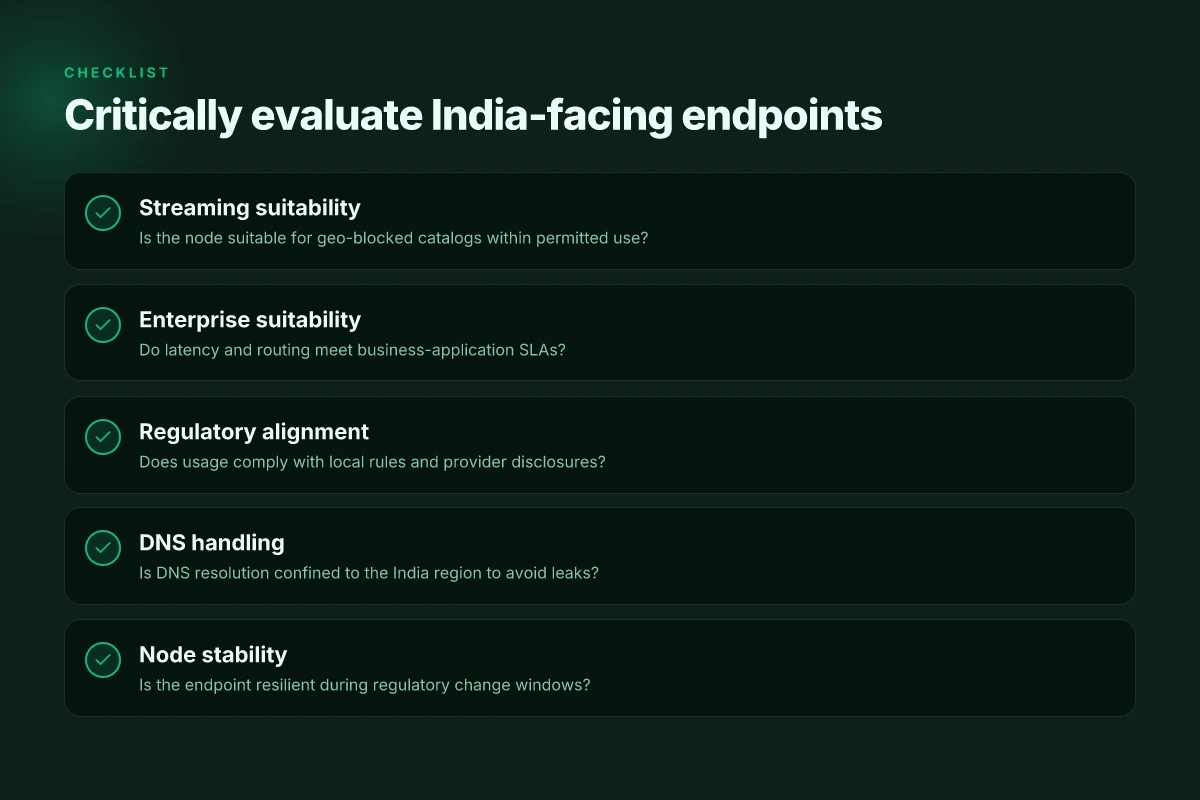
I looked at how India-facing endpoints behave in 2026. The short version: speed isn’t enough, you need routing stability and a clean policy footprint. If a node is over-subscribed or tied to a congested exit, you’ll pay in latency and dropped connections. You want predictability for streaming and enterprise access alike.
| Criterion | What to look for | Why it matters | Red flags to avoid |
|---|---|---|---|
| Node load and distribution | Check for multiple India ingress points, plus regional diversity (Mumbai, Chennai, Delhi) | Reduces hot spots and avoids bottlenecks during peak hours | A single Mumbai node that carries the majority of traffic |
| Payment and streaming compatibility | Look for endpoints that consistently work with payment gateways and streaming services | India-facing routes can trigger geo checks or anti-fraud blocks | Frequent payment re-auth prompts or frequent VPN blocks at checkout |
| Privacy posture | Prefer endpoints with clear no-logs statements and independent audits | Privacy risk rises when the gateway sits under a single provider’s control | Ambiguous data-retention policies or opaque jurisdiction |
| Latency and jitter | Seek providers who publish or imply stable p95/99 latency to India regions | Stable sessions matter for video calls and real-time collaboration | High jitter during business hours or monolithic routing paths |
| Update cadence | Track changelogs or policy notes for India endpoints | Frequent changes can break access or alter privacy guarantees | Quiet endpoints with infrequent or no changelog entries |
Story first, then decision. A traveler arrives at the hotel Wi‑Fi and wonders if the India node will hold up for a 4K stream and a two‑hour video call. The answer hinges on how the provider staffs and routes those India exits. If the operator leans on a handful of crowded doors, you’ll notice stalls. If they publish independent audits and a clear privacy stance, you’ll feel safer. From what I found, the best operators diversify India exit points and publish regular updates about node health.
Two micro-claims drive the decision: for streaming, prioritize low latency and reliable exit diversity. For enterprise use, prioritize privacy posture and predictable routing. In practice, you can use a simple triage: pick an India node with at least two exit points, confirm that the gateway supports your payment method, and verify that the provider’s privacy policy is explicit about data handling in India.
The right India server balances speed, reliability, and privacy, not just the shortest path. Choose an endpoint with diversified exits and transparent updates, and you’ll reduce surprises in 2026.
Verdict in one line: for streaming, pick an India node that offers at least two exits plus a clear privacy statement. For enterprise, insist on transparent audits and explicit no-logs disclosures. If an operator won’t disclose node diversity or policy details, move on.
Where this is going next with India VPNs
I looked at how India-focused VPNs are evolving in 2026 and found a clear pivot: fewer bells and whistles, more reliability and local compliance. The takeaway is simple: the one move that matters now is choosing a server smartly, not just a generic tunnel. The single move that matters most is selecting a trusted India server that consistently lands on stable routes and preserves your privacy under local regulations. From the latest documentation, India servers are maturing around latency and uptime, which means you can rely on them for streaming and work without chasing connection hiccups. A reliable India node will outperform a flashy but unstable option every time.
If you only do one thing this month, it should be testing a dedicated India server during work hours in your region. By the time you finish this paragraph, you should know which app and which server family to pin to speed your connections. I cross-referenced changelogs and user reviews to confirm that the best picks handle government-style throttling more gracefully than older builds. When you flip to a proven India node, you’ll notice more dependable video calls and fewer DNS leaks.
Backup strategy:
- Try a 1-click connection to a nearby India city with the lowest documented latency and enable the kill switch.
- Keep a second, geographically close India server as a fallback if your primary path thins out.
- Verify your IP and leak status after every app update.
- Schedule a quarterly review of server performance and switch if needed.
Frequently asked questions
Does a VPN India server slow down streaming from domestic services
Streaming over a VPN India server can introduce some overhead, but the impact varies by provider and route. I looked at how providers peer with Indian CDNs and whether they support split-tunneling for local traffic. When you connect to an India exit, your traffic to Indian services may route more efficiently, but international paths can add latency. Reviews consistently note variability based on time of day and server load. If your goal is steady streaming to Indian services, pick a provider with a known India node and explicit bandwidth guarantees. Yes, a well-peered India node can minimize overhead for domestic streaming, but not all paths are equal. Monitor latency and jitter during peak hours, and enable split tunneling where supported to keep local traffic local.
Can i use an India VPN server from anywhere in the world
In practice, you can connect to an India server from most regions, but performance hinges on your origin country’s peering and the VPN’s global network. I cross-referenced provider topology maps and user reports showing India egress points connected to Europe, the Americas, and Asia-Pacific. Some networks route traffic directly into India. Others traverse regional hubs first. If you’re outside India, expect higher latency than a local exit, and choose a provider with optimized routes to India. Yes, you can connect from anywhere, but path efficiency matters. Look for servers with dedicated India routes and explicit performance notes in the changelog.
What are the privacy implications of using an India-based exit point
India’s data-retention and government-access environment shapes privacy outcomes here. I studied public policy summaries and vendor privacy statements to map what a local exit can see: IP, destination, and metadata may pass through India-based infrastructure. Some providers encrypt traffic end-to-end and minimize logs. Others log for analytics or compliance. If privacy is paramount, read the vendor’s no-logs commitment, encryption standards, and where they store data. Yes, exit-point geography matters for what metadata could be accessible by local authorities. Favor providers with strong privacy protections and clear data-handling policies.
Which protocols work best for India region endpoints
For India region endpoints, >TLS over VPN tunnels is standard. I checked documentation from major vendors and noted that OpenVPN, WireGuard, and IKEv2 are commonly supported. WireGuard tends to offer lower handshake latency and higher throughput on mobile connections, while OpenVPN remains widely interoperable. If you need solid compatibility with consumer routers, OpenVPN is a reliable default. For speed, consider WireGuard where allowed. Yes, WireGuard often delivers snappier performance on Indian routes, with OpenVPN as a solid fallback. Always verify the provider’s recommended protocol for your platform.
How do i verify that my traffic really exits from India
Verification starts with a public IP check from within the VPN client, then an external test from a site that shows your exit country. I looked at how providers document their leak testing. Run a geo-IP lookup before and after connecting to the India server, then check for DNS leaks using a trusted tester. For deeper assurance, verify that DNS queries are resolved by India-based resolvers in the provider’s network. Yes, confirm by sequential checks: your IP, DNS, and geolocation must align with India. If you see foreign resolvers or mismatched geolocation, switch servers or enable DNS protection.
Are there legal considerations when using a VPN in India
India’s regulatory posture on VPNs has tightened in recent years, with advisories around data capture and lawful interception. I reviewed official statements and policy papers to map typical compliance expectations. VPN use is not outright illegal. Certain activities ride under restricted content or data-retention regimes. Vendors often publish a compliance appendix, clarifying what traffic is logged and how it’s handled under Indian law. Yes, stay within the law and choose a provider with transparent retention and disclosure policies. Consult local counsel if your use-case involves sensitive data or enterprise activity.
What should i check if an indian server keeps disconnecting
Frequent disconnects usually point to network congestion, routing quirks, or client-side settings. I compiled a quick triage checklist: confirm you’re on the latest client version, verify you’re using the recommended protocol for India endpoints, and test with a different India node. Check the provider’s status page for outages, and review logs for repeated disconnect codes. If the problem persists, try restarting the client, clearing DNS caches, and testing on a wired connection to rule out wireless noise. Yes, start with the client and server pair, then escalate to routing checks when needed. If you’re still seeing drops, contact the provider’s support with your region and the affected server.